
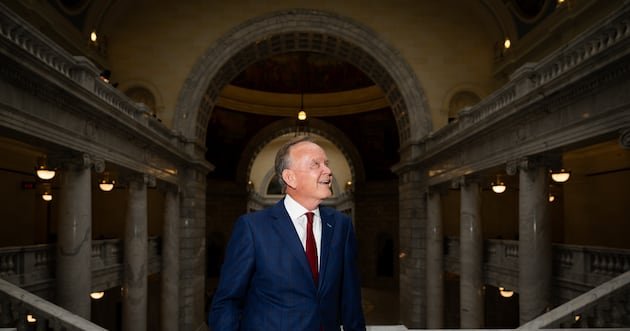
One of Utah’s most powerful lawmakers drove state investments in growth, deepened Utah’s international footprint and helped define the “Utah Way” on immigration, elections and LGBTQ rights during his tenure.
Then, in June, he became one of America’s most prominent victims of voter angst over artificial intelligence infrastructure.
In a Deseret News interview, Utah Senate President Stuart Adams doubled down on the project that propelled his stunning primary election upset. AI data center backlash, Adams said, was based largely on inaccurate beliefs.
“They had misconceptions about the water; they had misconceptions about a lot of the elements,” he said. “I think over time we’ll be able to understand the balance of what data centers will do and why we need them.”

Adams also defended the Military Installation Development Authority, or MIDA, the statewide zoning entity he chaired that outlined the Stratos proposal. Like data centers, the economic tool was misunderstood, according to Adams.
The 72-year-old lawmaker seemed surprised after nearly three dozen years of public service, and eight years as Senate president, that Utahns would not trust him to lead the charge into the rapidly advancing era of AI technology.

Adams had spent the previous several years touting the state’s No. 1-place plaudits on every possible occasion.
He presided over a Senate that helped drive Utah’s rise to the best state in the nation four years in a row, according to U.S. News & World Report, boasting the quickest population increase, greatest GDP gains and highest household income in the country.
These metrics are downstream from intentional policymaking, Adams likes to say. The Legislature prioritized six consecutive income tax cuts that were coupled with record-level spending on education.
Adams’ critics view his imprint on state politics differently — suggesting he orchestrated a sequence of legislative power grabs that weakened the state’s executive branch, punished the courts and gave the impression lawmakers care less about listening than asserting their will.
The truth may be somewhere in the middle. While perception carried the day for the voters who replaced him, Adams leaves a legacy intertwined with the Beehive State’s landmark legislative accomplishments and ascendant global presence.
‘Utah Way’ or the high way

The issue that first pulled Adams into Utah politics is the one that some see as his greatest contribution to the state.
Adams ran for Layton City Council in 1993 to make Highway 89 safer for his 16-year-old daughter. Nearly a decade later he ran for the state House to push for the construction of an alternative route to I-15 running through Davis County.
Infrastructure, for Adams, is synonymous with forward-looking investment to maintain the quality of life in Utah.
This belief put Adams in the middle of efforts, including as chair of the Transportation Commission, to reduce commute times with additional corridors, an expanded Frontrunner system and major new earmarks for transportation funding.
“I think he’s been an incredible force for good in the state,” said Natalie Gochnour, an economist serving as director for the University of Utah’s Kem C. Gardner Policy Institute. “If I had to pick a word, I would say that he’s been a builder.”
Adams understood, for an attractive state like Utah, growth is inevitable, Gochnour told the Deseret News. The lesson learned from Adams’ data center fallout, she said, is the need for public involvement to guide “purposeful” growth.

At times Adams saw his responsibility as a lawmaker to get out in front of public opinion, not just to respond to it.
In 2015, amid a culture war crescendo surrounding gay marriage, Adams was asked to broker peace between religious conservatives and LGBTQ activists in the state. To the astonishment of most involved, he succeeded.
As the sponsor of SB296, Adams balanced religious freedom protections with LGBTQ nondiscrimination in housing and employment, producing a model for the nation in the most Republican of states, former Gov. Gary Herbert recalled.
“We threaded the needle and brought both sides together,” he told the Deseret News. “I got calls from governors about every week for a couple of months, saying, ‘How did you do that?’ … And a lot of the credit goes to Stuart Adams.”
What Adams understands, according to Herbert, is that a democratic republic comes down to common-sense principles, not party-line coercion. This includes the “spirit of collaboration” that sets Utah apart, he said.
The 2015 law — which Adams loathes to call a “compromise” because in his view neither side gave up anything — fits within a Utah tradition Adams worked to fortify of forging common ground on hot-button issues.
He spent his concluding sessions on Utah’s Capitol Hill quashing attempts to reverse the state’s unique status as a red state with nearly universal vote by mail and statutes intended to integrate immigrants, legal and illegal, into the economy.
Despite coming under fire from the right, Adams said Utah’s Compact on Immigration has “held up well.” The Utah Way, as described by Adams, is akin to a legislative Golden Rule, that expanding access to the negotiating table benefits all.
Adams has gone to great lengths, and distances, to apply this conviction to Utah’s relationships around the world.
World Trade Center Utah CEO Jonathan Freedman met Adams on a 2023 trip to Ukraine where Adams led the first state delegation to meet with President Volodymyr Zelenskyy following the Russian invasion in 2022.
Some of Adams’ travels have been the subject of scrutiny, like a trip to a World Cup match paid for by Qatar after he led a trade mission to the Middle East. But his penchant for subnational diplomacy is rarely glamorous and often game-changing for Utah, according to Freedman.
“President Adams absolutely opened up international doors for Utah companies,” Freedman told the Deseret News.
Few things have been as rewarding for Adams as Utah’s ability to “make the world safer” through free markets, friendship and faith. But it was ultimately his invitation to a Canadian investor that helped to precipitate his primary election defeat.
President toppled

In January, Adams and Utah Gov. Spencer Cox met with celebrity investor Kevin O’Leary to discuss planting a data center campus, billed as one of the largest in the world, in Box Elder County, a rural area north of the Great Salt Lake.
The opportunity, Adams thought, was too big to miss. MIDA, with him at the helm, authorized an economic development area, including significant property tax relief, on the grounds that AI dominance is a national security imperative.
Within a few months, data center development went from an initiative Adams energetically championed to a political liability Adams feared could cost him his seat. By June, Adams was publicly asking O’Leary to shrink the project.
But outrage over the lack of public input and potential environment impacts soon dominated the race.
By the end of election night, Adams was staring at results that showed two-thirds of his Republican constituents had voted to oust him. In trying to fast-track infrastructure for the new tech landscape, Adams had failed to convey his vision.

He blamed the data center blowup on “untruths,” and the fact that “the Senate president was running for reelection.”
The rate public opinion — both in Utah and nationally — has flipped from neutral to overwhelmingly negative toward data centers has been extraordinary, said Darrell West, a senior fellow at the Brookings Institution Center for Technology Innovation.
Concerns extend beyond energy and water use, West said, with data centers becoming a proxy for broader AI anxiety that pushed out county commissioners in Utah’s Box Elder County, Millard County, and elected officials in Missouri and Georgia.
A top lawmaker with statewide influence falling to AI-buildout backlash appears to be unprecedented.
“It’s unusual such a powerful political leader got toppled by data centers,” West told the Deseret News. “Secrecy is always corrosive of the public mood. And when people don’t know what’s going on, they often assume the worst case.”
Adams denies he overplayed his hand on the Stratos project. There is “genuine concern” about data centers, but he said it derives from incorrect assumptions about energy supply, water usage and the military strength MIDA has enabled.
MIDA was an appropriate vehicle to incentivize O’Leary’s project, according to Adams. Stratos has a military interest, he said, because if places like Utah do not take the lead on constructing facilities for AI computer servers, China will.
“My question would be, do you want China to control 95% of the AI technology in the world?” Adams asked.
National security arguments aside, frustrated Utah voters are right to demand greater transparency and accountability in government processes that impact their quality of life, said state Sen. Kathleen Riebe, D-Cottonwood Heights.
The streamlined approval of Stratos is not an outlier, but rather part of a broader pattern of Adams’ GOP majority allocating tax dollars and approving developments against the wishes of local residents, Riebe told the Deseret News.

A trend emerged under Adams, she said, where the work of individual lawmakers was overridden by legislative leaders.
Going back years before Adams got the president’s gavel, Utah’s legislative branch has consolidated more control and eliminated certain checks by acquiring the ability to call itself into special session, expanding the size of the state Supreme Court and amending ballot initiatives.
These are positive developments, Adams said, because “you can’t give too much power to the elected representatives of the people.” He is ”optimistic” about the new justices on the bench, he said, after a string of defeats at the high court.
Adams would not say what was next for him, but he hopes to “stay involved.” He remains confident in Utah’s future, he said, because of the collection of leaders he leaves behind. State senators will vote on the next president on Nov. 6.
“I’m not perfect, but I’ve given it my very best effort to try to make the state the best state in America,” Adams said.