
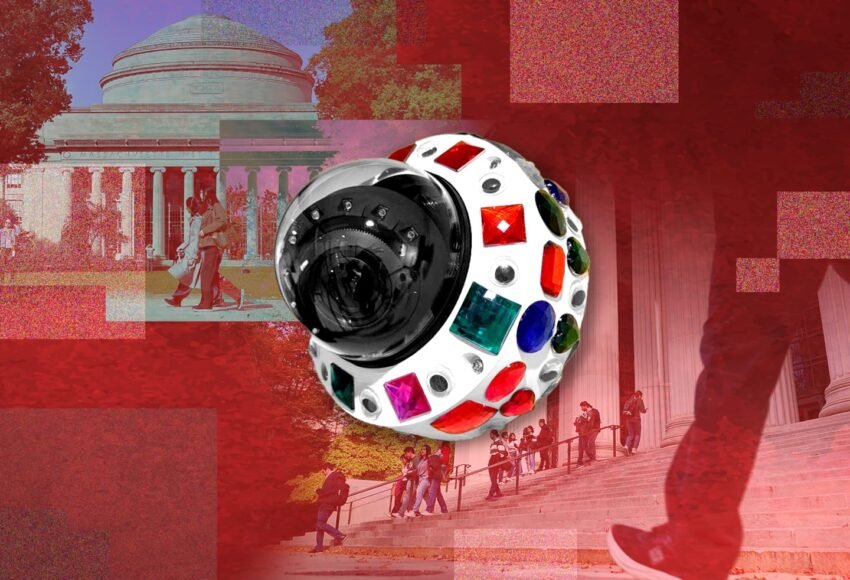
Once a week since summer, professors have roamed the campus to adorn security cameras with colorful, glitzy rhinestones and googly eyes. Unlike the more pointed sabotage by some activists to disable the Flock cameras that have generated so much controversy, the so-called white hat hacking at MIT is ultimately benign: the “bedazzling” doesn’t interfere with the operation of the cameras.
“We had to come up with another way of having a more open and democratic dialogue around surveillance on campus,” said Catherine D’Ignazio, an associate professor who specializes in urban science and data literacy.
Instead, given MIT’s standing as a leading frontier for new technologies and especially as one of the birthplaces of AI itself, the symbolism behind the protest is more the point — that the people responsible for bringing such breakthroughs to the public also have a responsibility to set the tone for their use.
“What precedent does this set for the broader community, if MIT were to start implementing this?” said Eric Lu, a fourth-year doctoral candidate in biological engineering and president of the Graduate Student Council at MIT. “When [MIT] speaks, people listen.”

The irony, of course, is that MIT is arguably the birthplace of AI. As far back as 1959, celebrated mathematician Marvin Minksy and his colleague John McCarthy founded what is now called the MIT Computer Science and Artificial Intelligence Laboratory; Minsky in particular spent years in the technological wilderness helping shape what seemed like a science fiction fever dream into the powerful force it is now.
Despite this history, it was a crime on another campus that ultimately helped frame the role of a larger surveillance presence on US campuses: the mass shooting at Brown University last December, when a gunman killed two students on campus and, later, an MIT professor at his Brookline home.
The location of the Brown shooter was established in part with the help of a Flock camera that had captured him on a Providence street. MIT began installing new cameras just before the shooting, in November, to close gaps in security coverage, according to a frequently asked questions page. Now, about 4,600 cameras watch the 168-acre campus.
It was the next step that kicked off the backlash in earnest. MIT then explored hiring a surveillance technology company, Ambient.ai, to monitor the cameras in real time and alert officers in the event of active threats or incidents.
But the MIT faculty members protested the introduction of AI surveillance, raising concerns about what could be done with the video data, as well as the risks of misidentifying people. They also have complained about who would have access to the data, as well as a lack of input from the community over its implementation.
Some even questioned whether the technology itself, impressive as it is, would really be that effective in making the campus safer.
“Is there data out there that surveillance cameras are the best way to cope with those crimes?” said Marah Gubar, a literature and comparative media studies professor who participated in the bedazzling of the cameras.
Following the backlash from community members, MIT’s executive vice president and treasurer Glen Shor told faculty members at a meeting on Oct. 21 that AI surveillance is no longer on the table.
“MIT will not be using AI in any way to observe or analyze campus activity,” Shor told the Globe. “Security camera footage plays an important role in helping the MIT Police understand and resolve safety issues and incidents such as theft, vandalism, and property damage that have been brought to their attention.”
Before the school announced it will not move forward with AI, the graduate student council sent a resolution to MIT administrators calling for student input on any adoption of AI surveillance, and research to justify its use.
The resolution came as many of Lu’s classmates and colleagues have taken note of alarming statements by former employees of AI companies warning about rogue agents hacking into secure databases and looming fears of a dystopian AI takeover.
AI is ”unproven ground,” said Lu, the council president. “So whatever you assess as a risk now, you don’t know what that’s going to look like in a month.”

But even stripped of AI capabilities, the sheer scale of the surveillance network on campus has created a “chilling effect” among community members who wish to exercise free speech, said Daniel Shen, a PhD candidate in electrical engineering and computer science and chief steward of the MIT Graduate Student Union.
If MIT has everything on video, Shen said, that will hurt “people’s willingness to engage in expression or political expression on campus.”
According to an institute presentation to faculty members, footage from the cameras can be used for student disciplinary purposes, with the written approval of a senior police officer.
Shen said that in his view, people felt safe on campus without the additional cameras.
In Providence, the shooting at Brown prompted the school to expand its camera network to about 1,950 by late August, according to a university report, although it is not using AI as part of its safety measures. A Brown spokesperson said the university had invested $65 million in campus safety since 2014.
The university commissioned a review that concluded there was limited camera coverage in the area of the shooting, and that more cameras could have aided in identifying the shooter sooner. But the report says additional cameras were unlikely to have prevented the attack.
This is the sort of surveillance paradox that Matthew Guariglia, a senior policy analyst at the Electronic Frontier Foundation, a technology civil rights organization, frequently points to. Additional surveillance, he said, does not on its own prevent crime.
“If crime goes down, you say it is working, and if crime goes up, you say you need even more cameras,” Guariglia said. “The way you make people safer is by addressing deeper-seated social issues that cause violence.”
Yogev Toby can be reached at yogev.toby@globe.com.