
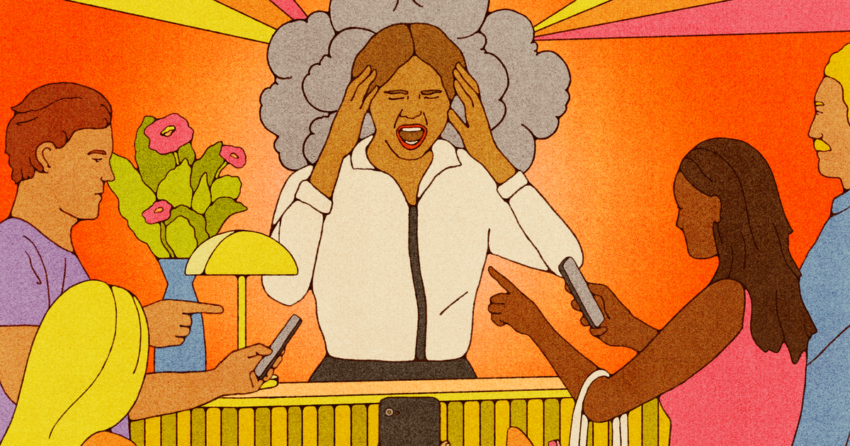
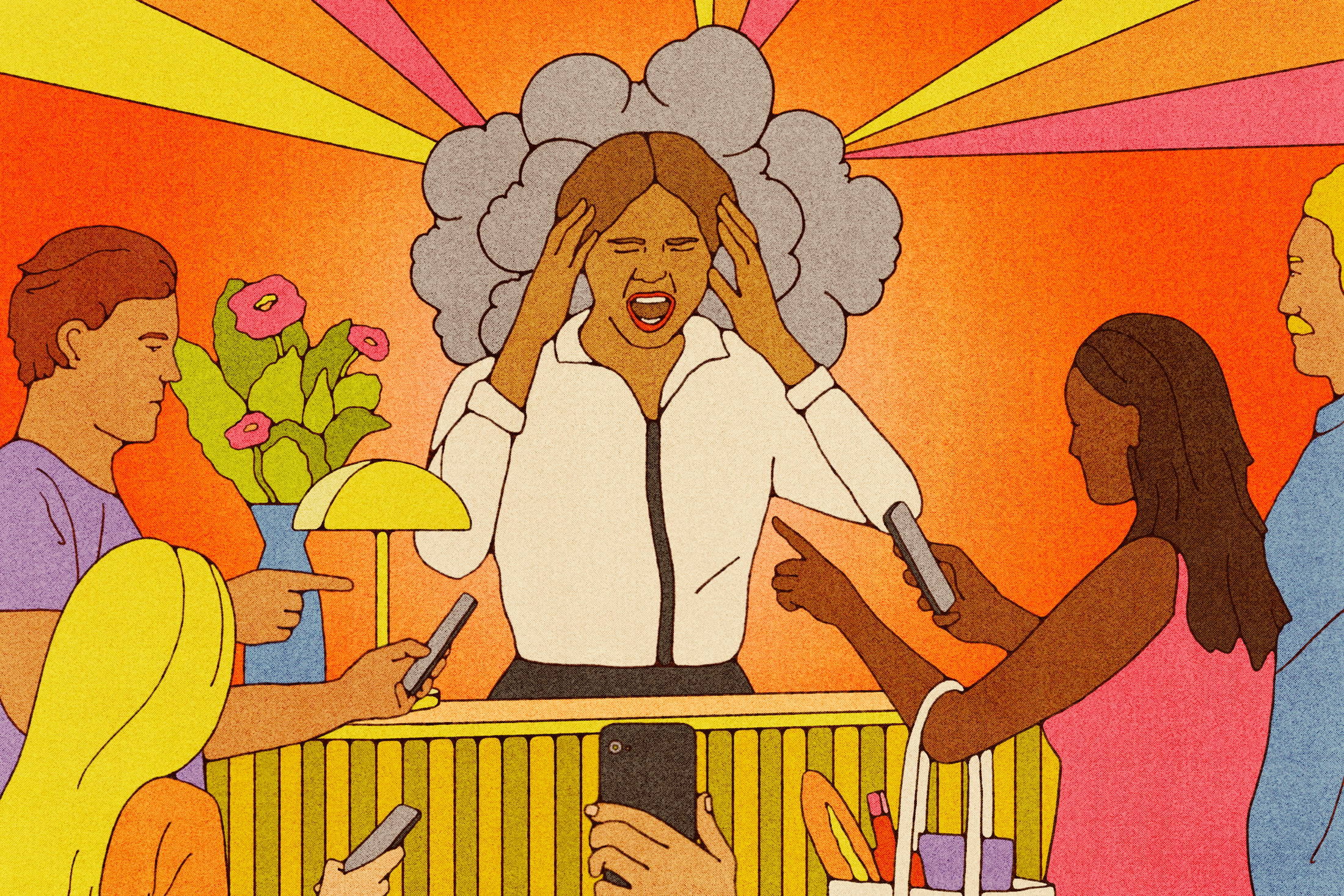
Illustration: Kate Dehler
At Crevette, the Riviera-inspired seafood restaurant that opened last year in the West Village, one of the most popular tables is one owners Patricia Howard and Ed Szymanski consider to be among the worst in the house. Unlike others, the table is not set against a wall and it’s positioned, somewhat awkwardly, in the path of anyone headed for the restaurant’s patio. Howard was confused when, starting a few months ago, a stream of reservations came in requesting to sit not at one of the restaurant’s curvaceous, inviting banquettes but at this table specifically.
Eventually, she asked one of these guests what had inspired their enthusiasm. “They said the table had gone viral on Rednote because of its ideal photo-shoot location,” Howard tells me. Angle a camera just so and you capture both a dainty floral chandelier and a whimsical, wall-size painting the restaurant commissioned from artist Michael McGregor. The table’s algorithm-guided fans tend to come at brunch, when the light is best, and often bring their own food to pose with. On several occasions, Howard says, they have not ordered food from Crevette at all.
Digital tools have been changing the way we interact with restaurants for almost 30 years, since OpenTable first replaced phone calls with mouse clicks in 1998. Instagram arrived in 2010 and transformed dinner into content; TikTok and Beli’s viral dishes have turned New York’s dining scene into a citywide scavenger hunt. But restaurant owners and the people who work for them say there is a new strangeness in the air and an unsettling sense that the public’s growing reliance on tech in dining has finally gone too far.
An executive for one prominent restaurant group tells me she estimates that half the emails she reads from unhappy diners are written by chatbots. The AI influence is easy to spot: “They all sound the same,” she says. “‘I’d like to file a formal complaint,’ then a seven-paragraph email about how they had to wait for a table. ‘I would like the following: an explanation for why this happened, a plan for how it can be prevented from happening again, and information about what type of compensation you can offer me.’ I mean, we’re talking about dinner.”
There was a time when a customer had to be really bothered to invest in writing a strongly worded letter to complain about it. Now, being able to off-load the effort to an AI helper means demands are not only frequent but extremely persistent: If a restaurant declines to give a refund, a second, lengthier note may materialize. Recently, the executive says, a woman who had been offered an apology but no credit fired back a long reply minutes later — and accidentally left the chatbot’s response to her prompt pasted at the top.
Amanda Signorelli, the co-owner of Golden Steer, has watched the same phenomenon close into a loop. A customer sends an AI-written complaint email, and “we respond in turn using AI, and if it goes to the credit-card company, their AI scans and responds,” she explains. “We’ve turned the whole thing into an AI circle.” Jon Neidich, whose Golden Age Hospitality runs the nightlife venues Le Dive, the Nines, and Saint Denis, tells me about a guest who contested a cancellation fee with what appeared to be a “fully lawyered document,” formatted and phrased like a demand letter. “Chat’s skills as a lawyer have always been one of the things that impresses me the most,” he says wryly.
Ashwin Deshmukh, a co-owner of Jean’s, the Noho bistro and subterranean nightclub, says his team has noticed a definite uptick in not only AI-written complaints but AI-written requests. “What we’ve also noticed is AI emails trying to pick at our empathy. ‘I need to switch this six-top because someone is dying’ — that type of thing,” he says.
But chatbots do more than write letters to restaurants; they assist customers with scanning food menus to count macros — “the ‘help me protein-maxx’ robot is here,” Deshmukh says — and they pick out the wine. “People using Claude and ChatGPT for the wine list is totally happening,” he adds. “The only way to circumvent it is if you have a somm they want to flirt with.”
And AI is making the reservations — badly. Bots, once the scourge of reservation platforms, may have been reined in, but tech-savvy dining enthusiasts can turn AI agents loose on the task to watch for an opening and grab it. Dorsia lets members (who pay fees up to thousands of dollars a year) lock in reservations by committing to minimum spends running into the hundreds of dollars. ResX lets members claim last-minute tables that other members post. Meanwhile, a new invite-only start-up called Spot books hard-to-get tables on your behalf for $15 to $50 a month. To a restaurant, an AI agent’s reservation looks like any other — until it doesn’t. “These AI bookings have the highest likelihood of cancellation and are most prone to errors,” Signorelli explains. They are also routinely padded: A table for five may be booked for a party that is in reality just two people. And all of these services deliver a guest to the door who has paid in advance and expects to be treated as someone special. “It has created this obscene customer who acts like a war criminal to the staff,” Deshmukh tells me. “If they’re seated ten minutes late, they’re going into the kitchen and yelling.”
Contrary to popular belief, great hospitality is not the responsibility of the restaurant alone. It has always depended on both the host and the hosted holding up their ends of an unspoken bargain. The staff agrees to pretend they are thrilled to see you, to be genuinely tickled this is your anniversary, and to take your food allergies (legitimate or otherwise) seriously. You, in turn, agree to pretend you are a reasonable person. Within that fiction, a remarkable amount can be forgiven — a late arrival for a prime-time reservation, a wrong order, a steak that comes out a little past where you wanted it — but how can a restaurant adequately appease anyone who outsources their end of the agreement to AI?
John Winterman, a partner at Francie in Williamsburg, started in the industry during the paper-and-pencil reservation era and has witnessed every technological shift since. “The things that have made it more convenient for the restaurant and customer have also created a bigger divide,” he says. Winterman recently received an AI-written complaint email from a guest who “had dinner, ate everything, and tipped 20 percent,” Winterman recalls. Five minutes after he walked out the door, the restaurant got an email listing a litany of complaints and asking for a full refund. “Needless to say,” Winterman says, “I did not accommodate him.”