
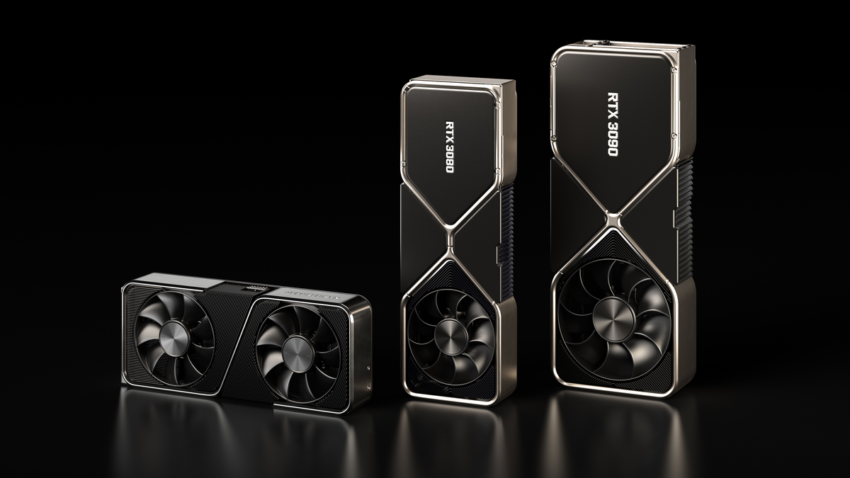
A new GPU unlock tool has unlocked the full potential of NVIDIA’s RTX 30 & RTX 40 GPUs, achieving faster AI LLM performance and compute capabilities.
Back in the crypto mining days, NVIDIA had the compute performance of its GeForce RTX 30 GPUs virtually unlocked through BIOS firmware and patches as it rolled out its mining-specific CMP line of chips. The CMP cards have also recieved a special unlock tool which exposes their full memory capabilities, jumping from 8-10 GB to 64-80 GB.
While modders managed to unlock the full mining rates, the compute restrictions were still in place. But that changes through a new open-source GitHub project called “Zagita,” which is unlocking the full BF16/FP16 rates featured on the Ampere GPUs. The tool is easy to use and doesn’t require any vBIOS flash or hardware modding.
Running the tool is simple, and it unlocks double the compute capabilities of NVIDIA’s RTX 30 series FP16/BF16 FMA across all GA102, GA103, GA104, and GA106 GPUs.
Unlock FP/BF16 instruction issue rate on Nvidia 3000’s cards to their professional equivalents
This Linux kernel module combines the CMP unlocker’s V67/PLM technique with the pre-driver timing of the UEFI approach. It runs the unlock, writes the speed selectors (SS0
0x88888888, which selects the full BF16 rate, and the 4-bit SS10x8IMLA4) and performs FLR before the unmodified NVIDIA driver binds the card. It is neither a UEFI application nor a patched NVIDIA driver.The benefit of this early kmod driver is that it does not require manual patching each time nvidia releases a new driver version.
The effect of this unlock is that it doubles the instruction issuing speed of FP/BF16 FMA into FP32 operations on GA102, GA103, GA104 and GA106 cards.
Many users are running the tool now and seeing a boost of up to 80% on the RTX 30 series GPUs. For example, the RTX 3090 Ti has its BF16 capabilities boosted from 87.5 TFLOPs to 157 TFLOPs & TF32 goes from 42.6 TFLOPs to 82.6 TFLOPs. Similarly, the RTX 3080 10 GB goes from 65 TFLOPs of FP16 to 113 TFLOPs at its stock 320W power.
| Power limit | FP16 | BF16 | per MHz | |
|---|---|---|---|---|
| Before | 300 W | 59.6 TFLOPS @ 1384 MHz | 63.0 @ 1462 | 0.043 |
| After, cold boot | 380 W | 100.3 @ 1208 | 105.9 @ 1269 | 0.083 |
| After, warm reboot | 350 W | 89.5 @ 1072 | 95.1 @ 1148 | 0.083 |
3090 Ti dense 8192³ GEMM at 450 W, five-sample medians with FP32 accumulation:
| Input | Before | After |
|---|---|---|
| FP16 | 87.46 TFLOPS | 118.39 TFLOPS |
| BF16 | 87.50 TFLOPS | 157.41 TFLOPS |
| TF32 | 42.58 TFLOPS | 82.61 TFLOPS |
In AI LLMs, an unlocked RTX 30 GPU was able to offer 33-36% faster Prefill (long-context) output, while the latency in TTFT (Time-to-first-token) was reduced by 25%. Decode performance wasn’t affected, and matrix-multiply performance remained identical.
| Chip | Card | PCI ID | Result | BF16 GEMM gain |
|---|---|---|---|---|
| GA102 | RTX 3090 Ti | 10de:2203 |
Unlocked | +68–80% |
| GA102 | RTX 3090 | 10de:2204 |
Unlocked | +25–67% |
| GA102 | RTX 3080 Ti 20 GB (OEM, GA102-250) | 10de:2205 |
Unlock completes, BF16 stays at half rate | — |
| GA102 | RTX 3080 10 GB | 10de:2206 |
Unlocked | +70–73% |
| GA102 | RTX 3080 20 GB (memory upgrade) | 10de:2206 |
Unlocked | +56–59% |
| GA104 | RTX 3070 | 10de:2484 |
Unlocked | +73–81% |
| GA104 | RTX 3070 Ti | 10de:2482 |
Not tested with this module (the same unlock worked from a UEFI port on Windows) | — |
| GA106 | RTX 3060 12 GB | 10de:2504 |
Unlocked | about +80% |
| GA103 | any | 10de:2414 |
No reports yet | — |
Currently, the unlock is only available on Linux platforms; Windows isn’t supported yet. The RTX 30 GPU lineup sees the biggest benefit, but the unlock does extend to older GTX 9, GTX 10, & RTX 20 series cards.
Even RTX 40 GPUs are seeing an uplift with these new unlocks.

Other users are also fine-tuning models on older RTX 30 GPU cards such as the 24 GB RTX 3090. A user has reportedly reached 381 tokens per second throughput on Qwen3.8-27B.
The AI model ran at a baseline performance of 82 TPS and improved to a 4.6x rate through optimized MTP, DFlash2 with context lookup, and an optimized lookup verification. We reported this story this week, and as models continue to be optimized on older cards, their prices are also seeing an uptick.
For example, the NVIDIA GeForce RTX 3090 24 GB was selling for around $1000 US, but since these reports, the prices have climbed past $2000.
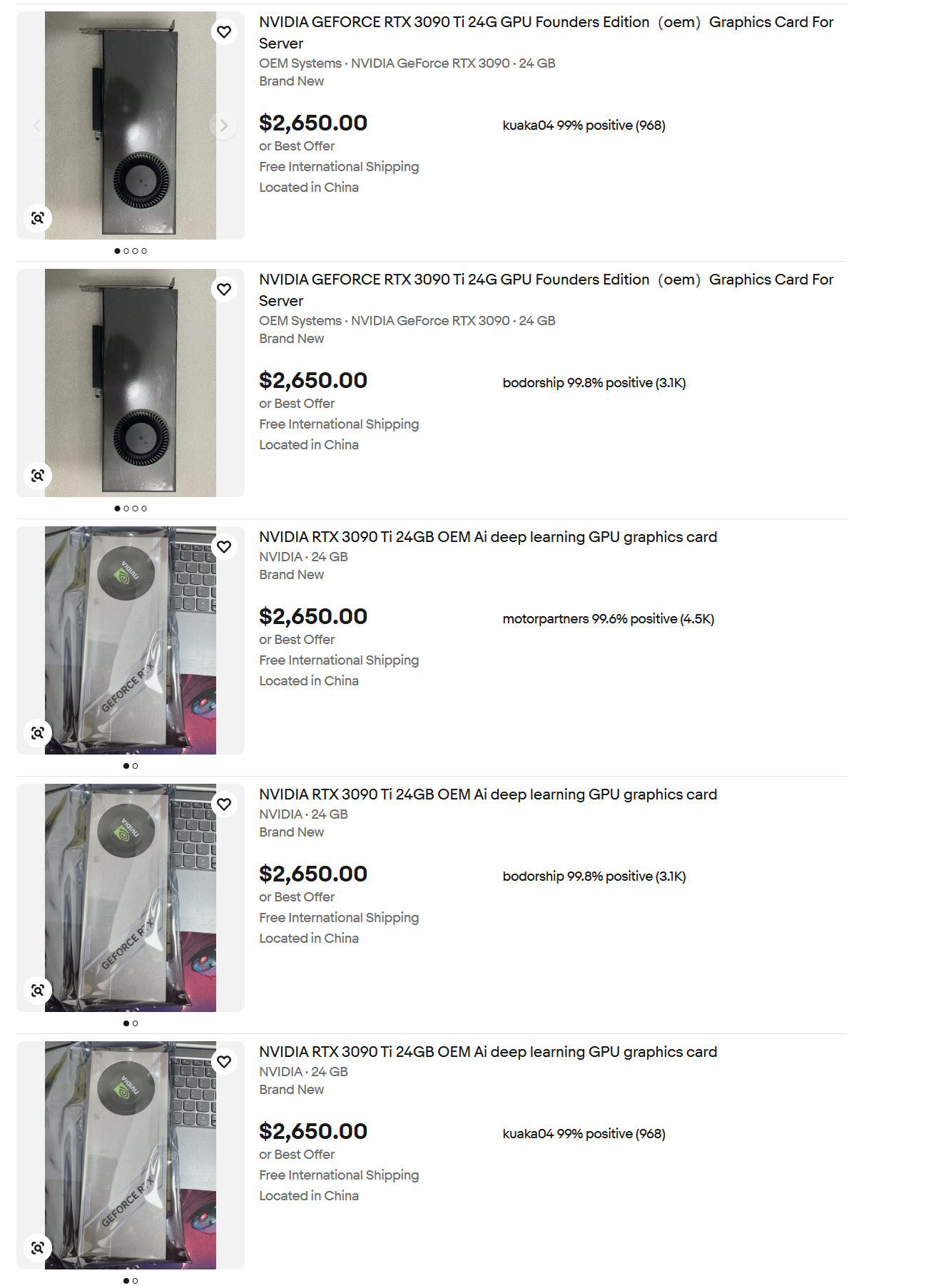
The RTX 3090 Ti is fast approaching the $ 3000 US mark, and the RTX 3080 10-12 GB models are reaching $900-$1100 US on eBay. The optimizations are giving Ampere graphics cards a new life outside of gaming, but that also means that gamers who were planning to purchase a used RTX 30 card will now have to deal with surging prices due to AI.
This unlock tool is breathing new life into Ampere-era RTX 30 cards for LLM workloads, delivering substantial compute gains that make them far more viable for inference and fine-tuning without any hardware mods. While the performance uplift is a clear win for AI enthusiasts, the resulting demand is pushing used-market prices sharply higher, turning once-affordable gaming GPUs into sought-after AI accelerators and making them less accessible for pure gamers.

About the author: A Software Engineer by training and a PC enthusiast by passion, Hassan Mujtaba serves as Wccftech’s Senior Editor for hardware section. With years of experience in the industry, he specializes in deep-dive technical analysis of next-generation CPU and GPU architectures, motherboards, and cooling solutions. His work involves not only breaking news on upcoming technologies but also extensive hands-on reviews and benchmarking.
Follow Wccftech on Google to get more of our news coverage in your feeds.