
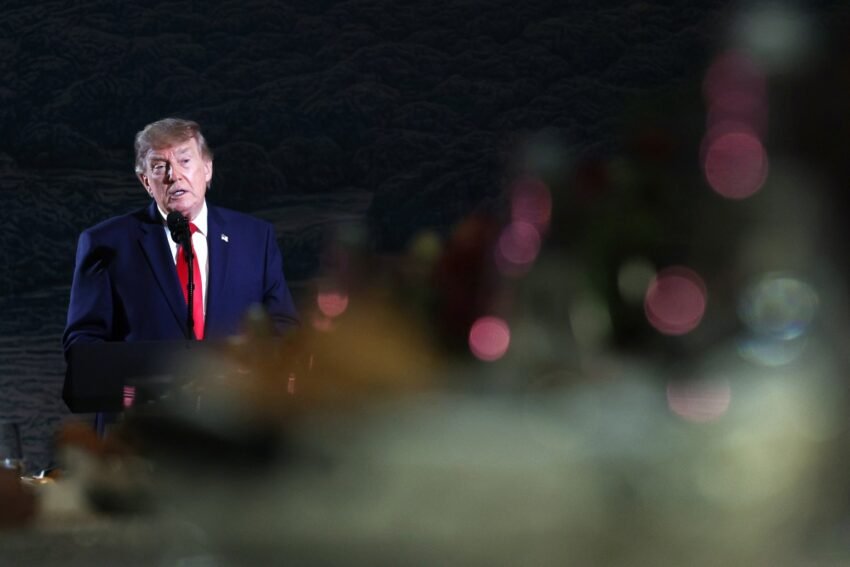
President Donald Trump said Tuesday that he was not worried about the wave of tech outages over the past week that have affected United States banks, Microsoft, and the Federal Aviation Administration (FAA), as Secretary of Homeland Security Markwayne Mullin pointed the finger at AI.
Speaking to reporters in Manilla in the Philippines, Trump was asked if he had spoken to any of the banks affected by Monday’s outage at JPMorgan Chase, and if he was concerned about the outages.
“No,” he said. “It’s life. When you’re big and powerful and have all the money, things like this happen. It’s fine.”
Read More on News
The president said he had spoken to U.S. banks who had told him the situation was “very much under control.”
Newsweek asked the White House if the president was concerned about the impact of the outages on the American people and businesses, and what the White House was doing to address the outages and the disruption they had caused.
Responding later Tuesday afternoon, the White House referred to Director of National Intelligence Jay Clayton’s remarks to CNBC and Fox News, in which he said the outages had not been a cyber attack.
“This is not a coordinated effort by a nation state,” Clayton told CNBC. “We’ve looked very closely. Anytime we see something like this, those are the first questions we ask on behalf of the American people.”
Clayton said what he suspected was going on was that multiple companies and government entities were updating aging infrastructure – with the process not running smoothly.
Trump’s comments come as other officials within his administration scramble to find out what has gone wrong in recent days, while Democrats called for greater accountability.
Speaking Tuesday, House Democratic Leader Hakeem Jeffries said it remained unclear if all recent outages were infrastructure related or down to “some malignant activity.”
“I think it’s time for the administration to come up to the Hill and explain themselves so we can be informed about the steps that need to be taken,” Jeffries told reporters.

DHS Chief Says AI May Be To Blame
Mullin suggested Tuesday morning that artificial intelligence may have played a role in the disruptions, telling Fox News that a technology expert had suggested that “super intelligence,” also known as artificial intelligence, could be responsible for the outages.
“These programs aren’t designed to work as fast as [artificial intelligence] is. And so when they put in a program that’s able to write codes, and it goes in and it self-fixes itself, as it starts self-fixing itself, it’s like doing a change order on a house. When you change one thing in a house, everything else starts changing. That’s a ripple effect,” he told host Sean Hannity.
Mullen suggested that fast-moving AI technology could overwhelm the older systems, which are unable to keep pace.
He also said it was highly unlikely a cyberattack was to blame for the technology disruptions.
“I can tell you with 98 percent certainty that we’re not seeing [a] cyberattack,” he said. “No one is out there taking claims for it, we’re not seeing the traffic, we’re not seeing the footprints going in, we’re not seeing the footprints going out.”
Newsweek contacted the Department of Homeland Security’s Cybersecurity and Infrastructure Security Agency for comment via email on Tuesday.
Authorities have not identified a common cause linking the recent outages. Mullin previously emphasized that there was “no connection” between the FAA’s rare nationwide ground stop and the issues with Microsoft services.

Outages Hit Microsoft, Banking and Aviation Industries
Last week, core Microsoft 365 services—including Outlook, Copilot, Exchange Online, and Teams—suffered a major global outage, impacting businesses worldwide.
Microsoft’s outages affected services across more than 70 countries, impacting businesses, governments and other institutions, as Newsweek reported previously.
Microsoft said Friday that its outage was the result of a “technical issue,” and was not related to AI or cyber agents. The tech giant’s executive vice president of Copilot, Agents and Platform, Charles Lamanna, later pointed to increased loads and reduced server capacity as contributing factors.
On Friday, the FAA grounded flights across the country for more than four hours after an instability in the agency’s legacy equipment disrupted aircraft communications and radar information. Some 12,000 flights were canceled Friday amid the disturbance, with disruption continuing into the weekend.
Meanwhile, customers of some of the biggest banks in America—including Chase, Bank of America, Wells Fargo, U.S. Bank, and Capital One—reported outages on Monday, though these had eased by Monday night.
A spokesperson for Chase told Newsweek transactions were posting normally as of Monday evening.
A JPMorgan Chase spokesperson told Newsweek the issue related to a “temporary issue related to a software bug in on-premise hardware systems,” and was not cyber-related. The spokesperson said delays at other banks stemmed from transactions involving Chase, which is a division of JPMorgan Chase.
Customers reported difficulties using banking apps, cashing checks, withdrawing or transferring money, and processing cashier’s checks.
Trump addressed the outages during a summit with Australian, Japanese, and Indian leaders, telling reporters that he was not concerned.
“It’s life. When you’re big and powerful and have all the money, things like that happen—it’s fine,” he said in a clip shared by the White House.
Former Trump Adviser Raises Questions Over Possible Cyberattacks
Michael Flynn, a former national security adviser to President Donald Trump during his first term, penned a lengthy social media post on Monday, suggesting the string of recent outages were suspicious.
“First Cox Internet, then Microsoft, then FAA, then AMTRAK, and today, it’s the banks, and being reported time now, American Airlines and United Airlines. Wow, simply breathtaking! One thing they all have in common; the open Internet,” Flynn wrote.
“Seriously, this looks and smells like a massive cyber attack. If nothing else, our adversaries are getting a hard look at vulnerabilities and if there is any effective, cross talk between governmental and nongovernmental institutions. It appears there is little to none.”
He added: “We’re past the stage of believing these are coincidental glitches due to faulty equipment or outdated infrastructure.”
Flynn served briefly as national security adviser for the first 22 days of Trump’s first presidency. He resigned in February 2017 amid reports he misled officials about communications with the then Russian ambassador to the U.S.
The retired U.S. Army lieutenant general has previously promoted unverified claims including that the so-called Deep State planned to put COVID-19 vaccines in salad dressing.
Update 11/17/26, 11:22 a.m. ET: This article has been updated with further information.
Contact Newsweek editors for this story: Matthew Robinson, Robert Greenall and Tony Phillips.