
In 2023, as the artificial intelligence boom took off, Alice Huang and her husband, Kang Wei, were pitching investors in Shanghai on a plan to build an A.I. business in Southeast Asia.
Working from a colonial mansion in the city’s former French Concession neighborhood, the couple boasted about Ms. Huang’s relationship with Jensen Huang, then Nvidia’s chief executive, who they said would guarantee a supply of powerful computer chips.
They also hinted at a deep-pocketed customer that would pay for access to those chips and anchor the business, according to two people who attended the meetings. The company created after those pitch sessions, a Singapore firm called Megaspeed, purchased more than $4 billion in Nvidia chips over the next few years.
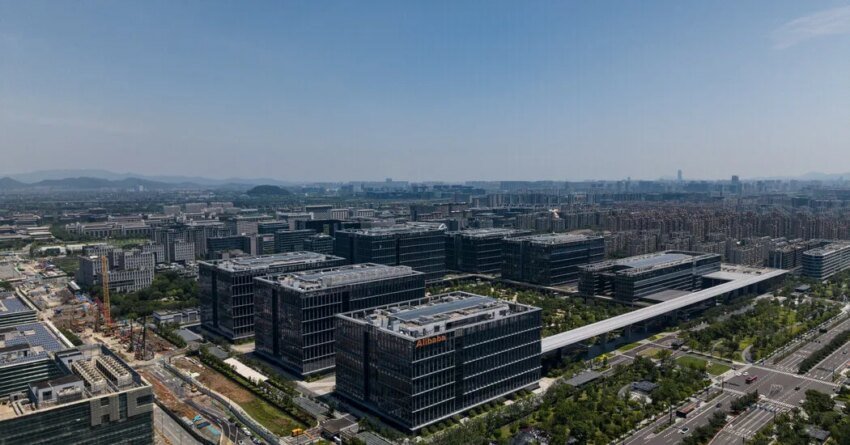
Megaspeed’s customer and financial backer turned out to be Alibaba, the Chinese internet giant, according to three people familiar with the relationship. Alibaba is a colossus, with a wide range of businesses. It also co-founded an A.I. lab with strong ties to China’s military, where researchers have worked on tasks such as automating cyberattacks and simulating war games.
For the past several weeks, Nvidia has been convulsed by revelations that Mr. Huang had an extramarital relationship with Alice Huang, who U.S. officials say is an asset for Chinese intelligence and was passing information to Beijing. But beneath the scandal is a geopolitical tug of war over access to the advanced Nvidia chips that help power the global A.I. boom.
The web of relationships between Megaspeed, Alibaba and Nvidia exposes a supply chain that often circumvents efforts by the United States to keep those chips out of China’s reach. The fact that Alibaba has access to the Nvidia chips and is only one step removed from the military-linked A.I. lab is exactly what intelligence officials in Washington have long feared. The technology could help China develop more sophisticated weapons, carry out cyberattacks and integrate A.I. into the battlefield.
The facility, called Zhejiang Lab, has another important link to Nvidia. Its current director, Wang Jian, was Alibaba’s chief technology officer and has had a long friendship with Nvidia’s Mr. Huang.
Whether Nvidia chips supplied by Megaspeed went from Alibaba to the lab is unclear. But the ties show how advanced computing reaches sensitive Chinese institutions through layers of contractors and resellers that obscure the origin of the chips. It also underscores how closely Alibaba, the company that anchored Ms. Huang’s business, was bound to the Chinese state.
The lab’s ties to Megaspeed and Ms. Huang’s business network, which ran through Alibaba and another smaller company, have not been previously reported, and raise the possibility that Megaspeed is providing Nvidia chips to support research for China’s military, which would violate U.S. law.
Megaspeed would buy chips for an offshore data center. Alibaba was its biggest customer. Together, the arrangement let Alibaba tap the powerful A.I. chips that American rules were meant to bar from China.
The complex ties, some of which were formed over the course of Mr. Huang’s roughly two decades doing business in China, raise questions about the checks Nvidia was supposed to conduct of its customers. The chips flowed to one of China’s largest tech companies at a moment when the Chinese leader Xi Jinping was pulling such companies closer into the orbit of the security state.
In 2022, Nvidia’s sales team introduced Alibaba to Alice Huang, according to a person familiar with the relationship. The introduction was first reported by The Information.
In Washington, the Nvidia scandal has inflamed an ongoing debate over access to powerful A.I. chips, as the fallout grows for the chip-making giant. Mr. Huang resigned last week after revelations that he also had another affair with an employee, and the U.S. government is investigating whether Megaspeed smuggled chips into China.
Mr. Huang has regularly dismissed the possibility that China’s military was interested in his product. He has argued that the Chinese military would never rely on American chips because Washington could block their export at any time, even as China’s military issued hundreds of public tenders seeking them. Mr. Huang did not respond to an emailed request for comment.
“Nvidia works across the industry to comply with the evolving rules regarding cloud services, while competing to build American infrastructure in every approved region,” said John Rizzo, a spokesman for Nvidia.
James Tan, the chief executive of Megaspeed, declined to comment on the connections between Alibaba, Megaspeed and military-linked institutions, saying in an emailed response that “this matter remains under independent review and that the company has not reached any conclusions.” Compliance with U.S. law is extremely important to Megaspeed, he said.
Evidence linking Chinese companies like Alibaba to the government and military often hides in plain sight, in academic journals, public procurement documents, government statements and patent filings. The New York Times also analyzed hundreds of Chinese records and interviewed a dozen people close to the process.
“Any suggestions that Alibaba provides services to the military is groundless. Alibaba Cloud’s service agreement strictly prohibits the use of our products and services for any military purpose,” an Alibaba spokeswoman wrote in a statement. In June, the company sued the U.S. government after the Pentagon put it on a list of companies it said are contributing to China’s military. The case is ongoing.
A spokesperson for the Chinese embassy in the United States said “the ‘Chinese spy’ allegation is purely unsubstantiated and directed at smearing China. China opposes politicizing and instrumentalizing trade and tech issues.”
Zhejiang Lab did not respond to emailed questions.
‘An incredible hero’
During a visit to Beijing in 2025, Mr. Huang spoke at an event with one of China’s most revered technologists, Wang Jian.
Mr. Wang created Alibaba’s cloud unit and pioneered some of its biggest A.I. projects. In more recent years, he had also been pulled deeper into China’s security state. By the time the two met onstage, Mr. Wang was the director of the military-linked Zhejiang Lab.
“He is the hero. He’s an incredible hero. A superhero,” Mr. Huang said to Mr. Wang onstage, noting his work with young people. It is not clear if he knew of the lab’s military ties.
Mr. Huang’s relationship with Mr. Wang stretched back more than a decade. After Mr. Wang built Alibaba’s cloud unit, it became one of Nvidia’s biggest customers, buying chips for a cloud service that was used by businesses and government.
The warmth between the two was reminiscent of an era when U.S.-Chinese relations were far better and China’s leaps in technology were viewed positively in Washington and Silicon Valley.
But over the duration of Mr. Huang’s long friendship with Mr. Wang, relations between their two countries darkened as Mr. Xi drew private technology companies into the sphere of state security.
Things changed for Mr. Huang, too. He had become a tech industry kingmaker, and his chips a strategic asset for governments. The U.S. government had begun restricting the sale of some Nvidia chips to China.
At the end of the 2025 meeting, Mr. Huang called Mr. Wang a “good friend,” and put an arm around him as they walked off the stage.
A few weeks before, Mr. Wang had taken a role even closer to the military as an expert adviser to the People’s Liberation Army’s National University of Defense Technology, according to a public announcement not widely reported. The institute was placed on a United States trade blacklist in 2015 over supercomputers that were believed to use American chips to simulate nuclear explosions.
Co-founded by Alibaba in 2017, Zhejiang Lab is the epitome of recent Chinese government efforts to blend civilian and military science. Some of its researchers probe the origin of radio bursts from distant galaxies. Others partner with counterparts in the Chinese military. One area of focus was combining A.I. with hacking techniques, according to a job posting. Other topics of research included remote sensing, automated cyberdefense and vulnerability identification, and information campaigns.
A postdoctoral researcher who listed the lab as her affiliation co-wrote a paper with scientists at a Chinese air force academy that described how to use computer simulations to war-game how to destroy or force away a foreign aircraft carrier group that had come to support an island’s bid for independence.
Some of the work done by researchers at the lab has run on Nvidia chips, which are more powerful and more popular than those of Chinese rivals. Nvidia researchers even copublished studies with authors from Zhejiang Lab.
Alibaba also won contracts for three stages of a computing center that provincial officials describe as built by the lab. The contracts were issued by a state-owned company, Zhejiang Computility, that sells computing power to the lab. Zhejiang Computility advertises access to export-controlled Nvidia chips. The technical specifications in a separate contract it signed with another supplier match those of Nvidia chips.
Mr. Wang has said insufficient access to A.I. computing power has held China back.
“If China is to walk at the forefront of artificial intelligence,” he said, “we still lack high-quality computing power.”
But when Zhejiang Computility sought bids for the computing cluster in 2024, Nvidia was barred from selling chips that powerful to China. Another supplier to the company that year, Hangjin Technology, has a joint venture with Century Litong, another company linked to Mr. Kang and Ms. Huang, the former Megaspeed executive.
In September 2025, a few months after Mr. Huang’s visit with Mr. Wang, Nvidia and Alibaba announced a new collaboration: Nvidia’s robotic development tools would be integrated into Alibaba’s cloud to help train autonomous vehicles and robots.
Malaysian Rules
In December 2023, Jensen Huang’s company plane made an overnight stop in Malaysia during a tour of Asia to meet with the country’s prime minister, Anwar Ibrahim. Announcing a deal for a data center in the country’s southern state of Johor, Mr. Huang said Malaysia had the potential to become an A.I. “manufacturing” hub for the world.
The project, on a former palm plantation larger than Central Park, was to be built by the Malaysian industrial conglomerate YTL. Nvidia pledged to provide some of its most advanced chips.
The setup was part of a multibillion-dollar data center boom underway in Malaysia that has made it one of the world’s largest computing hubs. Across the southern state of Johor, cranes swirl over massive construction projects underway to meet the demand from Chinese and American companies.
It is here that these webs of companies from China, Singapore and elsewhere form the opaque supply chains.
At the YTL facility, Megaspeed’s subsidiary, Speedmatrix, operated Nvidia chips inside the facility on behalf of Alibaba, according to five people familiar with the project who were not authorized to speak publicly.
Computer systems running on YTL’s network at the facility also bear Alibaba’s name, according to an infrastructure analysis by Infrawatch, an intelligence firm. That included software to remotely monitor equipment at a data center.
YTL did not respond to requests for comment.
The arrangement shows how Alibaba used a network of companies in Malaysia and other Southeast Asian countries to access powerful Nvidia chips that they would not otherwise be able to purchase or bring to China.
Alibaba’s links to the YTL facility in Malaysia help explain how the process worked, according to two people familiar with the development.
First, Alibaba would pledge to be a customer of a regional company, like Megaspeed. Then Megaspeed would use that agreement to raise money from investors to buy Nvidia chips, said the people. After securing the chips, Megaspeed struck more deals with companies like YTL that built data centers to operate the chips. Sometimes, the people said, chips bound for the data center were smuggled into China.
Once the facilities were up and running in recent years, Alibaba and its customers could access the Nvidia chips remotely. From the Malaysian data center, fiber optic cables send data to an internet connection hub in Singapore, which then links to China through undersea cables.
American officials believe China’s military uses the overseas data centers to train A.I. models, but then runs its A.I. operations from facilities inside China.
Nvidia’s Mr. Huang argued that China’s government would never accept the security risks of using foreign data centers and chips. But China-linked companies are involved at each step of the process.
Megaspeed buys its Nvidia servers from a company called Aivres, which is an American subsidiary of Inspur, a Chinese tech giant with deep state ties. At Megaspeed’s new data center, repairs and installation are also done by engineers from another Shanghai company, connected to Ms. Huang, according to two people familiar with the operations.
Other Chinese tech giants have created similar arrangements to access Nvidia chips. In Southeast Asia, data center companies including DayOne, Bridge Data Centers and Aolani provide computing power to customers based in China, according to public records and people familiar with the deals.
DayOne and Bridge Data Centers did not respond to requests for comment. Aolani declined to comment about its customers.
Now the future of the boom has been thrown into question. American officials recently strengthened export rules to prevent companies like Alibaba from remotely accessing Nvidia’s chips.
That puts projects like the YTL facility in Malaysia in the spotlight. YTL’s stock price fell about 20 percent over two weeks as scrutiny grew of Megaspeed’s operations in the country.
If things go bad for Megaspeed, Alibaba put a contingency in place. A business agreement between an Alibaba subsidiary and Megaspeed pledges all servers, chips, intellectual property, and other equipment back to Alibaba if Megaspeed fails to meet its contractual obligations.
Ana Swanson contributed reporting from Washington.