
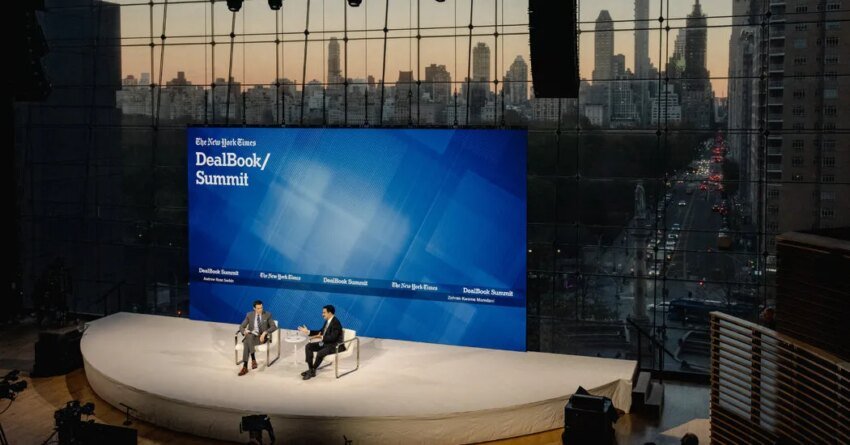
The promise and peril of artificial intelligence, America’s shifting politics and what it means for businesses and global trade, the reverberations of Jensen Huang’s ouster at Nvidia on Silicon Valley and Wall Street, and more dominated the discussions at the annual DealBook Summit on Wednesday.
Over the course of the day, speakers, including Elon Musk and OpenAI’s Sam Altman, dug into A.I.’s growth (and security) challenges. There was also plenty of chatter about the speakers’ relationships with President Trump before and since Election Day, including from Prime Minister Mark Carney of Canada and Mayor Zohran Mamdani of New York.
There were quirkier moments, too. Polymarket’s chief executive, Shayne Coplan, said he had A.I. agents trading on his laptop in his green room as he spoke.
The annual summit, hosted by Andrew Ross Sorkin, founder of DealBook, has taken place since 2011.
Here are six main themes that emerged.
The potential A.I. bubble
The morning started off with comments on the debate that has gripped Wall Street: Is the recent tech-stock sell-off a blip, or a sign the A.I. industry is doomed to run out of steam? Christine Lagarde, president of the European Central Bank, warned that while growth in A.I. had helped keep the global economy resilient, it might not end well. There is a “very ambitious price valuation which stands to be corrected eventually,” she said.
On the flip side, Mr. Altman, the chief executive of OpenAI, an A.I. powerhouse expected to go public as soon as next year, downplayed the “ups and downs of valuations.” Overall, he said, the “trend is going to be strong.”
The debate took on extra emphasis with Anthropic pricing a record-setting I.P.O. valuing the giant at more than $1.5 trillion. Its shares are set to begin trading on Thursday.
“These companies are remarkably consequential companies for the future of the economy, the future of society,” said Adena Friedman, chief executive of Nasdaq, whose stock exchange will list Anthropic’s shares.
The A.I. security challenge
Beyond the financial fears of how fast the A.I. industry is growing is a fear of how powerful the technology itself has become. Greg Brockman, a founder at OpenAI and its president, said A.I. safety had become a bigger conversation (and focus at his company) as models became more capable.
“Models are now capable enough that we need to think about safety, security, alignment — that’s new,” he said. “And that’s actually been a huge cultural shift.”
Both he and Mr. Altman stressed the need for humans to retain a tight control of the technology. Microsoft’s Satya Nadella, for one, sounded skeptical that so-called alignment — the science of teaching A.I. to broadly follow human preferences and instructions — is fully possible.
Palmer Luckey, chief executive of defense contractor Anduril, sees a potential dark cloud, however. He said he believes the recent wave of tech outages bedeviling airlines, banks and our digital lives had an A.I. angle. He blamed attackers using A.I. tools to target outdated infrastructure.
“As of right now, there’s a mismatch between the attackers, who are very fast-moving in using technology and old, outdated systems that are not able to adopt technology as quickly as it is developed,” he said.
President Trump’s shadow
Mayor Mamdani of New York City explained a bit about how he maintains an amicable relationship with President Trump. Mr. Mamdani, a democratic socialist, said the key to dealing with the president was “to focus on any possible area of commonality — and the reason for that is the stakes are so immense.”
He gave the example of how he called the president to plead his case, asking for a relaxation of rules to help the city’s bodegas and small retailers meet new federal food-stocking rules.
Prime Minister Carney of Canada, who met with Mr. Trump earlier in the day on the sidelines of the Asia-Pacific Economic Cooperation summit in Shenzhen, China, has found negotiations on the countries’ trade spat progressing slower than he’d like.
But he also offered a paradoxical view. In certain settings, Mr. Trump comes across as personable and engaged.
“He listens a lot more in private,” Mr. Carney said. “I mean, he’s interested, genuinely, in your opinion, and it’s a reasonably direct conversation.” Even so, Canada is advancing trade ties with China while talks with the Trump administration remain stalled over their tit-for-tat tariff war.
Governance watchdogs have long called into question business figures’ close ties to the president and his family — an issue that could draw serious scrutiny from a Democrat-controlled congress.
David Ellison, chief executive of Skydance, could be one under the political microscope. In conversation with Mr. Sorkin, Mr. Ellison took on issues as big as press freedom and as small as “Rush Hour 4.” Skydance’s decision to greenlight production of the film was for creative and commercial reasons, Mr. Ellison said, not because the studio was pressured to do so by Mr. Trump, who was previously reported to have requested the studio to revive the franchise.
Mr. Ellison’s media conglomerate, Paramount Skydance, was born out of a mega merger with Warner Bros. after the Justice Department this summer shuttered its investigation into the deal. Mr. Ellison’s father, Larry Ellison, has a close relationship with Mr. Trump.
“We’ve been fortunate enough to be able to work closely with this administration,” Mr. Ellison said. But, he added, “when we started the Paramount deal, that was under the Biden administration” with whom “we were working very closely.”
Later in the day, Mr. Coplan of Polymarket defended his company’s ties to Donald Trump Jr., the president’s oldest son, who’s an investor in the company via his venture firm 1789 Capital, saying the relationship is “heavily overblown.”
Jensen Huang’s ouster
The tech bosses on the agenda — Mr. Altman, Mr. Luckey of Anduril and Mr. Nadella of Microsoft — all expressed empathy toward Mr. Huang’s predicament after his ouster last week from Nvidia after reports of his affair with a woman whom U.S. intelligence believes to be a Chinese asset.
Some in the Trump administration have suggested Nvidia’s parting with Mr. Huang, who has said he would like a shot to return to the chip making giant, is the right move. Treasury Secretary Scott Bessent said this week that the company needed a “dramatic shake-up” — widely interpreted as a call for new blood to run Nvidia.
Tech leaders have had kinder words. Mr. Altman told Andrew Ross Sorkin: “I wish Jensen the best. I wish Nvidia the best. I don’t think the world needs another set of random opinions on what’s going to happen here.”
Mr. Musk, like others in Silicon Valley, said Mr. Huang was irreplaceable.
“Let’s say you’re the Chicago Bulls, middle of your second season, and you’ve got a winning streak that’s just going to happen, and then you kick Michael Jordan off your team,” Mr. Musk said, adding that “doesn’t seem like a smart decision to me.”
Markets, wagers and more
Prediction markets, platforms that allow users to wager on real-world events like election outcomes and sports, have taken financial markets by storm.
Traders on Polymarket, for example, can and have wagered on what speakers at the DealBook Summit would say. Such bets have drawn heavy scrutiny.
“Mention markets are entertaining, that’s for sure,” said Vlad Tenev, chief executive of Robinhood, whose company has banned such wagers. “But they’re also easy to manipulate.”
Mr. Coplan of Polymarket had a more charitable view about the rise of prediction markets in general, arguing it is giving rise to a new type of savvy investor.
“People have gravitated to that as an information source,” he said. “And that’s the thing that I’m really excited about.”
Social media’s addictive draw
Some speakers also talked about being way too online.
Hailey Bieber, the entrepreneur who sold her Rhode beauty brand for at least $800 million last year, said she was “100 percent” a social media addict. She, too, feels insecure after looking at people online, she said.
“It can be distorting to the mind, especially those filters that change your face. They make your lips bigger, your nose smaller,” she says. “That definitely can be harmful and misleading.”