
[UPDATE] Responding to our own X post, the Epic Games CEO clarified:
The anti-distillation feature is garbage. Claude’s leading edge models are quite excellent overall.
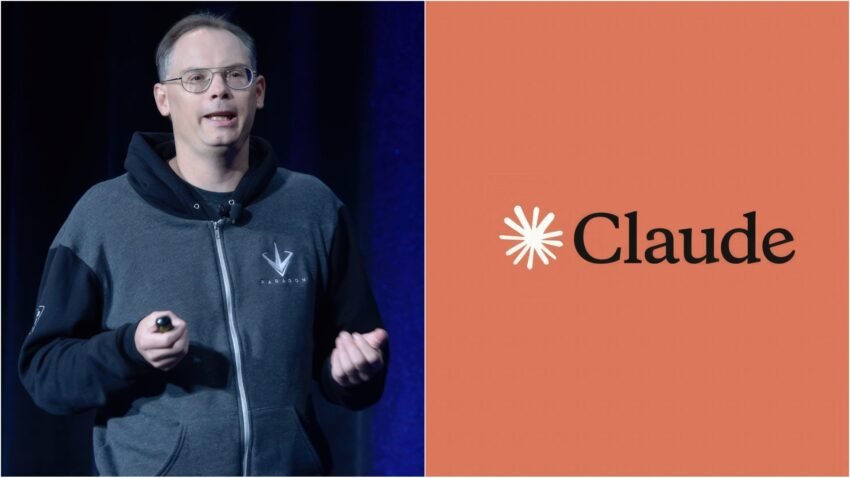
[ORIGINAL STORY] Epic Games CEO Tim Sweeney has just lambasted Claude AI, the large language model and flagship product developed by Anthropic, which last week pushed the San Francisco-based software company to set the new record for the largest-ever IPO at $1.5 trillion.
On X, the outspoken executive answered a post that criticized training models with Claude and doubled down on the criticism:
It’s garbage and blocked some set theory work I was doing, accusing me of distillation. This was with 1-2 hours a day of prompting on a company account. Anthropic can’t keep sabotaging customers’ work like this.
Reading between the lines, Sweeney complains that Anthropic’s automated anti-scraping safeguards wrongly identified his legitimate math and programming research as an effort to extract Claude’s intelligence and train a competing AI.
In AI, distillation involves querying a powerful ‘teacher’ model, such as Claude, to produce high-quality answers and then using those responses as training data for a smaller or competing ‘student’ model. Frontier AI companies like Anthropic strictly prohibit this in their terms of service to prevent competitors from cheaply reproducing their models’ capabilities.


Set theory is a foundational area of mathematics focused on collections of objects, formal logic, and mathematical structures. As the CEO of Epic Games, Sweeney works extensively on programming language design, including Epic’s own Verse language; in the tweet, he claims he was engaged in this work when Claude suddenly blocked him. Essentially, Sweeney argues that Anthropic’s anti-distillation detection is overly aggressive and prone to false positives, disrupting paying customers engaged in ordinary, legitimate work.
Some gamers may find this ironic, as the Epic Games CEO has famously backed AI advancements like those featured in Claude. For about a year, he has maintained that digital game stores shouldn’t require generative AI disclosures, since most game developers already use AI tools in some capacity. Valve’s Steam requires such disclosures, while his Epic Games Store does not.
Following the announcement that Epic’s Unreal Engine would integrate LLMs like Claude and Gemini through MCP (Model Context Protocol), Tim Sweeney admitted the risk of increased AI slop from low-effort developers, but also claimed that real creators would find it an accelerant for their work. Epic has now confirmed that Unreal Engine 6 won’t ship with Blueprints at all, trusting AI tools to perform an almost automatic conversion of UE5 to UE6. Even as a game developer, Epic has “retooled for maximum AI acceleration“, although Tim Sweeney said the goal is to make better games, not to reduce the number of employees.
As for Claude, its advanced capabilities are behind the latest flood of AI-assisted and generated mods and recompilations. It was also used to “copy” other games and release scores of quick demos during the recent Steam Next Fest, forcing Anthropic to update Claude Code to prevent game cloning.

About the author: With over two decades of experience in gaming journalism, Alessio Palumbo has led the gaming vertical at Wccftech since August 2015. He started working at a young age for Italian websites like Everyeye.it, Gamestar.it, Nextgame.it, and Multiplayer.it before kickstarting the indie English-language publication Worlds Factory as its founder and Editor in Chief.
In the last decade, he has coordinated the overall output of Wccftech’s gaming section, managed PR relations, assigned reviews, produced daily news coverage, edited gaming content as needed, and delivered game reviews.
Arguably, his trademark content is the long series of exclusive developer interviews that have been cited by Wikipedia and by the biggest news media and gaming publications.
His passion for technology also makes him knowledgeable when it comes to gaming hardware and tech. His favorite genres include RPGs, MMORPGs, and action/adventure games.
Get Wccftech in your Google feed
 Follow on Google