
Stay informed with free updates
Simply sign up to the Cyber Security myFT Digest — delivered directly to your inbox.
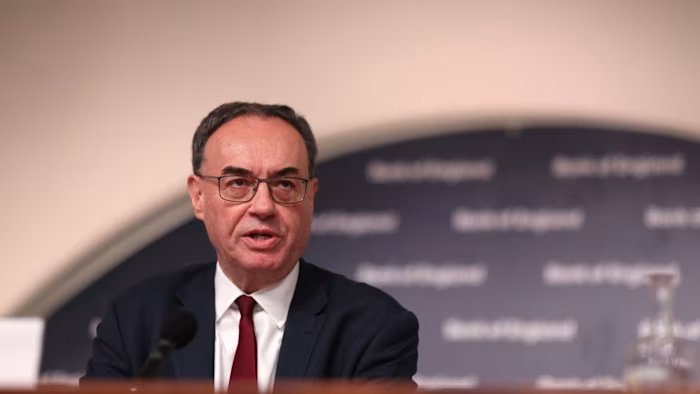
The governor of the Bank of England has sounded the alarm over recent AI-driven breakthroughs in mathematics that have stoked fears that the encryption used to safeguard data across the financial system is under threat.
Andrew Bailey said he was aware that companies developing the latest AI models were “expressing concerns that these models have got even more powerful” and this was causing “quite a bit of caution” on how they were “released into the world at large”.
When asked whether he was aware of AI models being capable of cracking encryption methods, Bailey said: “We talk to the companies quite a lot and we are, as they put it, on the exponential part of the development curve.”
Computer scientists have speculated about such an advance on social media in recent days, though no AI company has publicly released any material to this effect.
“I would argue very strongly that the companies are right to be cautious about releasing [the latest] models,” the BoE governor said on Thursday, as the central bank released its financial stability report.
New AI breakthroughs in maths have heightened concerns that models could reverse-engineer the calculations that underpin online security, such as the multiplication of large prime numbers.
Last week, an Anthropic employee said he had used the company’s Claude AI model to prove the Riemann hypothesis, a 167-year-old conundrum that is one of the most famous problems in maths.
On Wednesday, computer scientist Scott Aaronson published a widely circulated blog post in which he said he was “virtually certain” that AI labs were “sitting on one or more bombshells” in the mathematics relating to encryption.
While saying he did not know the specific nature of these advances, he predicted leading AI models would produce algorithms that would “break currently deployed cryptosystems”.
Anthropic declined to comment.
The surge in AI maths capabilities has raised the prospect that companies and governments might have to accelerate encryption upgrades intended to address the more distant potential danger posed by quantum computers.
Banks around the world are currently planning to upgrade their systems after 2030, based on the projected timeframe for quantum computing to advance to the point it could unlock encryption.
“If you talked to the AI companies, they would tell you they were taken by surprise by the power of the models coming into the market in the spring and since then,” Bailey told reporters. “That has slightly pushed quantum computing into the background. But you can’t forget quantum computing as it is still coming.”
Some cryptography experts and mathematicians said the highest-profile recent developments unveiled publicly didn’t appear in themselves to pose an immediate threat, but did show that AI aptitude in mathematics is increasing at a striking rate.
“This is a warning to areas of cryptography that lean more heavily into pure mathematics,” said Daniel Shiu, cryptomathematics professor at the University of Manchester.
“In the coming years, we must expect that some of these methods will fail quickly and with little warning,” he added. “This reinforces the argument for cryptographic agility . . . which is the major cryptographic challenge of the 21st century.”
On Thursday, the BoE for the first time told financial groups to prioritise updates of their cryptographic codes to guard against them being compromised by advances in AI or quantum computing.
“Developments in quantum computing, as well as advances in frontier AI, could increase risks to the cryptography used to protect confidential data or secure critical processes,” the central bank said in its financial stability report.
It said “firms should prepare for this transition by identifying where cryptography is used across their IT estates, mapping dependencies supporting vital services, and developing prioritised migration plans”.
“A cryptographically relevant quantum computer does not yet exist, but the quantum landscape continues to advance, challenging assumptions” about when such a technology could emerge, it added.
Bailey, who also chairs the global watchdog The Financial Stability Board, called for more international co-operation on testing AI models before and after their release.
“We have got to see other countries come on board with this, whatever your view of multilateralism in countries around the world, and you probably know who I am talking about,” said the BoE governor. “These are common risks. AI does not stop at the borders. We need to tackle these issues together.”