
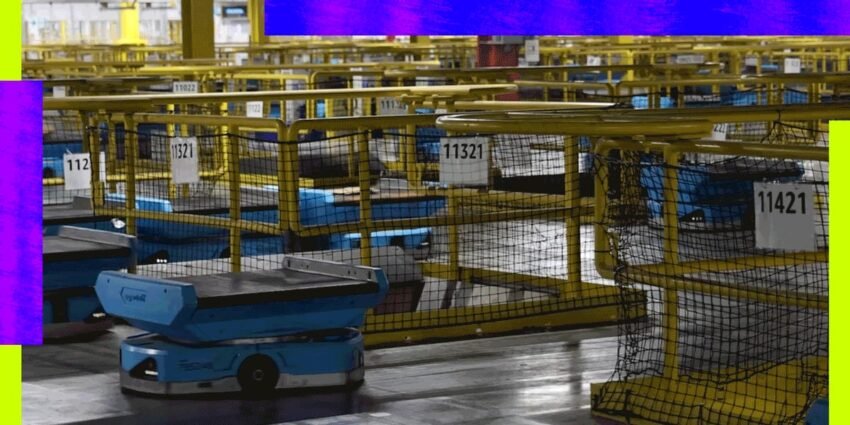
Amazon warehouse workers used to spend much of their days walking, pushing carts through long aisles to manually retrieve customer orders from shelves.
Today, hundreds of “Hercules” robots do this instead, carrying towering yellow storage pods filled with inventory to employee workstations.
“I’d walk like 10 miles a day on average,” said Mohammed Khan, who started as an entry-level picker 12 years ago and is now a senior manager at an Amazon warehouse in Tracy, California.
Amazon’s robots “cut down all that walking time,” he told Business Insider during a recent tour of the facility.
Jess Lynn Goss for BI
This site is ground zero for a wave of automation that’s beginning to wash over the industry. The warehouse and logistics sectors have been powerful sources of job growth since Amazon kicked off the e-commerce revolution 30 years ago, as Business Insider’s award-winning Warehouse Nation series revealed in 2022.
If robots automate many warehouse tasks, this powerful engine of job growth could grind to a halt, wiping out thousands of positions and countless opportunities for future workers.
Amazon says employees are being retrained to do more valuable work, such as managing and maintaining robots. Will these new jobs be enough to cover what might be lost? Or could we actually end up with more or better jobs?
Business Insider went looking for answers inside the giant facility in Tracy, a city in California’s Central Valley where suburban neighborhoods give way to open farmland.
“Autonomous to an extent”
Jess Lynn Goss for BI
Across 1.4 million square feet — the equivalent of 23 football fields — robots with names like Hercules, Robin, Cardinal, Pegasus, and Proteus move inventory and sort packages. But they don’t run the warehouse alone. Human workers still pick and pack orders, load trucks, and intervene when automated systems fail.
Jobs have not disappeared, but they’re changing. Machines increasingly handle work that once required employees to walk miles and lift boxes, while workers monitor and troubleshoot them. The Tracy site employs more than 3,000, up from roughly 1,000 when it opened in 2023, an Amazon spokesperson told Business Insider.
“They’re autonomous to an extent,” Khan said of his robot counterparts. “They still need a lot of help and maintenance and oversight.”
Jess Lynn Goss for BI
An Amazon spokesperson said rising customer demand drove the facility’s workforce growth and that robots help workers process more packages safely and efficiently rather than simply replacing them.
Amazon’s more automated, next-generation fulfillment centers are about 25% more productive and cut order-processing time by as much as 25%. And these sites support roughly 30% more skilled jobs in areas including reliability, maintenance, and engineering.
Jess Lynn Goss for BI
The “Quarterback” watches robots
One of the workers now doing that kind of job is Briana Brager.
She joined Amazon about two years ago as an entry-level employee after spending years caring for her family. She had no prior experience in a traditional workplace.
Today, she’s a process assistant who helps oversee the warehouse’s robotic systems. When a chute jams or a robot stops working, she coordinates the response to keep packages moving.
Jess Lynn Goss for BI
“The robots do a lot, but we still have to maintain them,” she said.
Brager began as a picker before moving into a specialized role supporting robotic-floor operations. She got two weeks of intensive training, followed by additional job shadowing, to learn how to work safely around the equipment. Her current job is less physically demanding than her previous one, she said.
Her role is informally known as the “quarterback” position. She monitors fleets of robots and dispatches employees when a machine needs intervention.
“We call the shots,” Brager said.
Meet Robin
Jess Lynn Goss for BI
At the Tracy warehouse, humans and robots move orders together from storage to the loading dock. Employees stow individual items in fabric inventory pods, which Hercules robots carry to pick stations. Workers retrieve the items, then pack and label them.
Robin, a large robotic arm, picks finished packages off a conveyor and places them on small Pegasus mobile robots. Pegasus carries the packages to staging areas alongside other orders headed to the same destination. Cardinal then loads the sorted orders into carts, and Proteus ferries the carts toward outbound trucks.
Jess Goss for BI
Khan, the warehouse manager, said workers performed Robin’s task manually until a few years ago. They handled packages one at a time, checked them for damage, scanned them, and fed them into the sorting system. He estimated that one Robin can perform roughly the work of two to seven people doing that process manually.
Amazon said that when it introduces systems such as Robin, employees take on other work at the site, including operating robots, clearing jams, monitoring the robotic floor and quality control, and maintenance engineering.
Robots move the carts, too
Proteus offers a clear example of how these new warehouse jobs are taking shape. Amazon brought the robots to Tracy last year.
Jess Lynn Goss for BI
Unlike Hercules, which operates in fenced-off areas, Proteus can move through spaces shared with people. There are roughly 200 of the robots at the Tracy facility, Amazon said.
Before Proteus arrived, workers manually pushed carts filled with packages to the loading dock. Now the robots pick up full carts, carry them to staging areas near the dock, and retrieve empty carts for the return trip.
Some employees who once moved those carts now work as “ground-floor monitors,” Amazon said. Instead of spending their shifts moving packages, they respond when a Proteus reports a fault. If the problem is simple, they can reset the robot; otherwise, human maintenance staff take over.
Some workers trained in these jobs have gone on to Amazon’s mechatronics apprenticeship program, which can lead to more technical maintenance work.
Jess Goss for BI
When automation hits the “jackpot”
For all the robots moving through the Tracy warehouse, people remain essential when automation breaks down.
Amazon calls one such destination the “jackpot.” When an item loses its routing information while moving through the facility, the automated system sends it to this area, which works a bit like a lost-and-found for packages.
Here, a human worker must determine where the wayward package belongs and return it to the correct flow. “It will require manual intervention,” an Amazon representative said.
Other situations require human judgment, too. Products can fall from storage pods and inventory can be damaged or mislabeled. Packing individual products into boxes and loading them onto delivery vehicles are tasks that also remain heavily dependent on people.
Jess Lynn Goss for BI
This helps explain why even a highly automated Amazon warehouse still employs thousands of workers. The company said it needs people for new packing stations as well as roles across the facility that keep operations running safely and efficiently.
Current and future Tetris
By the time packages get to the loading dock at the Tracy facility, the robots are gone. At least for now.
A person loads each trailer. Amazon uses equipment that extends into the trailer and adjusts to a worker’s height, reducing bending and back-and-forth walking. But workers still arrange the packages themselves, trying to fill the trailer to use as much of the space as possible.
“It’s a lot of Tetris,” one Amazon representative said.
Jess Lynn Goss for BI
Amazon is already exploring how to automate this task, though. As Business Insider previously reported, Project Tetromino aims to use AI and robotics to automate sorting and vehicle loading at delivery stations, where the work has long remained stubbornly manual.
But that vision remains a work in progress. Amazon’s machines can carry shelves, sort packages, stack boxes, and move carts around people. Workers still pack orders, load trailers, perform quality checks, handle hiccups and exceptions, and keep the machines running when they fail.
For Amazon, the immediate payoff is not necessarily a warehouse with fewer people, but one where the same workforce can accomplish more. Tracy employs roughly the same number of people as a nearby Amazon facility with fewer robots, company officials said, but the Tracy location processes more volume.
Jess Lynn Goss for BI
Khan compared the technology to something far less futuristic: a calculator.
The robots streamline work that once consumed employees’ time without necessarily eliminating the work itself, he said. “It’s not that the amount of work has changed,” he said. “It’s how we approach it.”
Asked whether robots could eventually replace more jobs, including his own, Khan did not try to predict the future.
“Who knows? That’s not in our purview right now,” he said. “But I would say roles are evolving, and that’s the cool aspect about it.”
Have a tip? Contact this reporter via email at ekim@businessinsider.com or Signal, Telegram, or WhatsApp at 650-942-3061. Use a personal email address, a nonwork WiFi network, and a nonwork device; here’s our guide to sharing information securely.