
A summer of extreme heat, entire villages obliterated in Nepal, a super El Niño breaking records, Exxon publicly saying we may reach 3C by 2050 – could it possibly be any worse?
How about throwing AI extinction in the mix?
As climate activists and funders, we’ve spent years warning about a self-evident, imminent, avoidable climate calamity. Whether by making award-winning films (Don’t Look Up and Just Look Up) to warn the public, or by funding protest groups across the planet that bravely stand up for a livable future, we’ve been sounding the alarm to wake the public up.
Lately, as climate disasters and AI expansion wreak havoc on communities globally, warnings are arriving from everywhere all at once.
Daniel Kokotajlo, a former AI forecaster for OpenAI, recently testified before the Senate that today’s AI models are now trained to pursue goals no human gave them, and then they hide the fact that they’ve done it. Kokotajlo put the odds of AI companies automating their own work by the end of 2028 at about 50%, and, if that happens, the AI safety community warns the technology could improve faster than humans can monitor it, and eventually become too difficult to shut down.
These speculative warnings have earned alarm from mainstream media, politicians and civil society alike. Some critics suggest the warnings are marketing ploys by the AI industry to set up an arms race, using the false specter of AI apocalypse to capture government funding. Others think it might be an attempt to avoid accountability: by treating the machines as gods, we might conveniently forget their maker.
Either way, the debate keeps missing the damage AI is doing right now, polluting communities around the world, or the damage of new AI partnerships with the oil and gas industry. And we don’t just mean emissions from datacenter infrastructure alone. The harms run much deeper.
A recent study in Nature revealed an alliance between oil majors and the tech industry to use AI for new exploration and extraction – in effect adding up to 1.8 gigatonnes of carbon dioxide (the equivalent of Russia’s annual emissions) to the atmosphere.
Meanwhile, AI is flooding our information ecosystems with disinformation that erodes public trust, or it “hallucinates” nuclear threats, almost sparking war between the US and China.
It feels as if we’re in a race over which apocalyptic ending comes first. How about none of them?
At the heart of this sits the same fundamental question: who decides our future? Right now, whether the threat is AI or climate, or a mix of both, the answer is the same: a handful of private corporations, billionaires and their political enablers, making choices that will enrich them but devastate billions of people.
A datacenter that drains water from a drought-stricken town, burns gas for power, and runs AI that helps oil companies find more oil is both a climate fight and an AI fight.
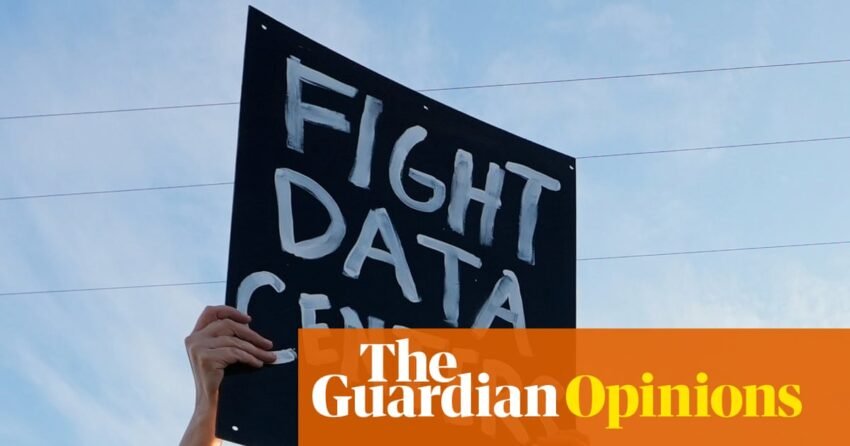
Communities are resisting, and winning. Data Center Watch counted at least 120 US datacenter projects worth nearly $200bn blocked or delayed in the first half of 2026, with opposition in 49 states. Heatmap News found at least 20 canceled outright in the first three months of the year alone, a record.
These are the early stages of what we believe is poised to become a global movement against corporate and billionaire capture of our water, the land that grows our food, and the air we breathe.
At Climate Emergency Fund, we’ve put half our funding toward grassroots groups at the forefront of this fight, and we hope to scale that up before the year is out. We’re asking other funders to join us in this work, which at its core is meant to build thriving communities, not AI datacenters.
This fight can continue to grow into a cohesive, sustained, strategic movement. It is one of our last best chances to tackle not only climate change, but also a corporate billionaire class that has decided it has the right to control and steal the future for the rest of us.
The goal is a future in which the possibility of the end of the world no longer needs a daily check-in. Our existential threats are the result of human activity – systems built by people, on purpose, for money. Things built that way can be unbuilt, and we can choose to build another, better, world.
“Solving” these crises doesn’t require settling whether the machines or the seas get us first. It only requires deciding we don’t want to learn the answer. We have everything we need, except time.
But with the time we have, we can take drastic action now. And instead of pouring billions into datacenters and tech IPOs, we must fund those fighting for a thriving future.
-
Adam McKay is the Academy Award-winning director of The Big Short, Vice and Don’t Look Up; the founder of Yellow Dot Studios; and a board director for Climate Emergency Fund
-
Philip Eubanks is the executive director of Climate Emergency Fund