
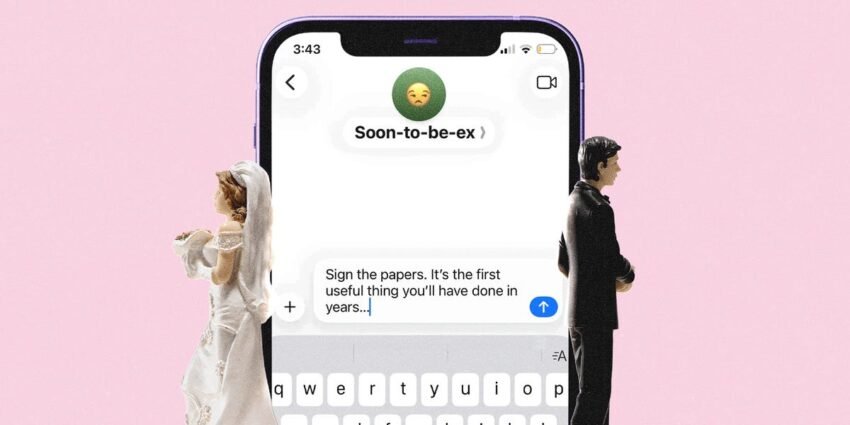
When Angela Mason’s ex took her to family court last year, she spent more time talking to ChatGPT than her attorney.
At stake was whether their relationship fell under the parameters of common-law marriage. To prepare for a trial and argue it did not, the 49-year-old from Houston relied on the chatbot to interpret legal documents, rehearse testimony, and learn, as she puts it, “basically, knowing when to shut my mouth.” Mason delegated email editing to the chatbot, prompting it to take out profanity and soften her blunt demeanor. In May, she won the case.
“It was really my lifesaver,” Mason says of ChatGPT. “It definitely helps to have someone — or not even someone, something — there that can help you navigate your emotions when it comes to your words.”
People don’t like it when their friends, family, and coworkers rely on AI translators to talk to them. Armchair experts drive doctors crazy with endless ChatGPT diagnoses. But family law occupies a singular corner of the court system where emotional volatility and logistical snafus merge. Divorce is often the only time someone will interact with attorneys and courts at length, and they do so while nursing heartbreak and anger, and navigating their first days as a single parent.
“AI could fundamentally change divorce,” says Nicole Sodoma, a family law attorney in North Carolina. “Not just how people get divorced, but also how they experience divorce.”
Attorneys I spoke to for this story cautioned against using AI extensively and acting without lawyer oversight. Family law is nuanced; AI is predictive. Two-thirds of family law cases have at least one party representing themself, and more of these people may turn to AI in a financial pinch. It can cull disparate documents, like bank statements, emails, and calendars for child custody, taking on the tedious paper trail divorce creates. At a time when many want nothing to do with their ex, they might welcome texts and emails edited by AI that mute raw human emotion in favor of clean and concise, if not robotic, communication.
Elliott Crain, a 48-year-old father of two from Georgia who divorced a few years ago, built SayWell, an AI program that would intervene in text messages, offering to reword them if they got too heated. For example, if someone types, “you are just a pain in the ass,” the application flags it as a “high-conflict message” and blocks delivery. Heated exchanges accusing someone of withholding kids might get rewritten to say something like: “The parenting agreement indicates that I am supposed to have the kids. Can you bring them to me?”
Many criticize AI for robbing art, writing, and communication of its humanity. But during a divorce, people may find appeal in automating their way out of the emotional and financial burdens. The legal industry won’t change quickly, so some AI-pilled divorcees are building their own solutions.
Sodoma has adopted AI a bit quicker than some other family law attorneys. In one recent divorce case, she received a letter from the opposing counsel, on behalf of their client, littered with name-calling and baseless allegations. Forwarding it to her client verbatim would “escalate the conflict tenfold,” she says. With her client’s permission, Sodoma plans to have AI summarize it, acting as a sieve that strains out the animosity while preserving the necessary details. In the past, she would do this in her own words, but it’s one way that AI can speed up her work and potentially save clients money.
The average divorce takes about a year and costs a client more than $11,000. Lawyers have leaned into automation, while remaining wary of AI hallucinations: 85% of legal professionals say their firms have adopted AI, according to a report by Clio, a legal tech and AI company. The results haven’t yet drastically reduced the time and cost of legal proceedings, but AI has begun to disrupt how lawyers charge for their work. Big Law firm Baker McKenzie just announced it would shift away from billable hours and instead charge fees based on the outcome of the legal work. That might lower costs for clients and give attorneys more time to handle more lawsuits, which makes more money for the firm.
Many family law firms are small, and therefore priced out of earlier AI tools, says Ed Walters, vice president of legal innovation and strategy at Clio. As prices drop, the barrier for small firms’ experimentation falls. “It’s not that it’s magical AI that replaces lawyers,” Walters says of the current state of the tools. In addition to helping with paperwork, Clio can also act as a sounding board for attorneys to test out their cases, but gives feedback that doesn’t flatter their arguments without pushback. Automation, Walters says, makes room for the human part of family law as it “moves the computer out from between lawyer and client, so that lawyer can be in direct counsel and support for someone going through the worst year of their lives.”
One attorney, Gabrielle Hartley, built an AI tool called Mediator Gabby to guide people through the information-gathering process of mediation more quickly. Hans Guntren says he founded the AI tool Deliberately for attorneys after going through a divorce himself. It’s intended to store and sort through documents related to a case, and to give attorneys up-to-date summaries of each. Guntren says his personal experience taught him that divorce “is like doing your taxes times 100,” and after a career in tech, he wanted to build something that managed the tedious parts of it. The divorce industry is just starting to welcome automation. “They’re not doing any of this yet,” he says. “It’s just hitting.”
For divorced parents, AI may dull the agony of ending a romantic relationship with a partner, while staying in touch to co-parent. They see it as a tool that can handle the dark moments of a breakup and potentially ease the transition for their kids.
Crain, the divorced dad in Georgia, says his text-message intervention tool SayWell has seen slow uptake because it requires both parties to opt in. Neither person wants to admit that they might be the problematic ex, and separating couples often need something like SayWell most when they trust one another’s suggestions the least. “Trying to get these two people that are fundamentally in disagreement about everything to agree to something to even get it started was a deal killer,” he says.
Sol Kennedy built BestInterest, an app that uses AI to filter and edit messages, manage schedules, and track receipts, after he went through a divorce several years ago. If someone sends an aggressive text, BestInterest acts as a wall to absorb their anger, pulling out the relevant information and relegating the insults to a separate file they can access if they need the messages in court. It doesn’t require both parents to opt in. Kennedy says BestInterest’s users are split, about 60% women and 40% men, with the women, he says, more likely to report dealing with a “higher conflict co-parent.”
His own divorce inspired the concept. “It was difficult to detach from that conflict,” he says. Now, a few years removed and raising an 8-year-old and a 10-year-old, he still turns to AI for advice about his kids’ emotions and how to address them. “It doesn’t feel as lonely when you have an AI partner for parenting,” Kennedy says. His app is an extension of that mindset, and includes coaching for parents. “I see this as an opportunity to educate co-parents on how to co-parent well.”
For Mason, having ChatGPT at her fingertips during her common-law marriage trial made the horrific process a bit easier. She had gone through a divorce before mass adoption of AI chatbots. “Had AI been available back then, I certainly would have taken advantage of it,” she says.
AI won’t make divorce as simple a process as getting married. Divorce attorneys bemoan clients who come to them with AI-drafted documents, hoping lawyers can just send them through the court system and finalize their separations quickly. AI’s sycophantic nature also risks bolstering the one-sided breakup story a person might feed it, overly eager to validate their position and provide an analysis that ignores their ex’s side of the story. AI hallucinations are increasingly popping up in court documents, with one project tracking at least 155 fake legal citations found in family law decisions. The ability to generate financial records and photos with AI will call into question what evidence is real and what is fabricated. Even speedier attorneys still collide with slow-moving courts, which hesitate to innovate. “You might have asymmetrical efficiency gains, so part of the work is much faster, but the other part isn’t,” says Walters.
Jamie Berger, a family law attorney in New Jersey, says most clients now come to her door after doing their own research using AI. She has to temper client expectations, explaining that the law is nuanced, and walk them through the minefield of co-parenting. Using AI for the latter might create “a false sense of amicable communication and co-parenting that maybe isn’t actually occurring; it’s just occurring in the written form,” she says. Eventually, two co-parents will have to meet up in driveways, at school band concerts and ballet recitals, and graduations — and they won’t have an AI mediator between them.
For all that AI can do, it can’t override the messiest parts of divorce. “Divorce — especially — it’s human,” Berger says. Just as we risk losing skills by cognitively offloading too many tasks to AI, we might lose something when even separated people stop talking to one another.
Business Insider’s Discourse stories provide perspectives on the day’s most pressing issues, informed by analysis, reporting, and expertise.