
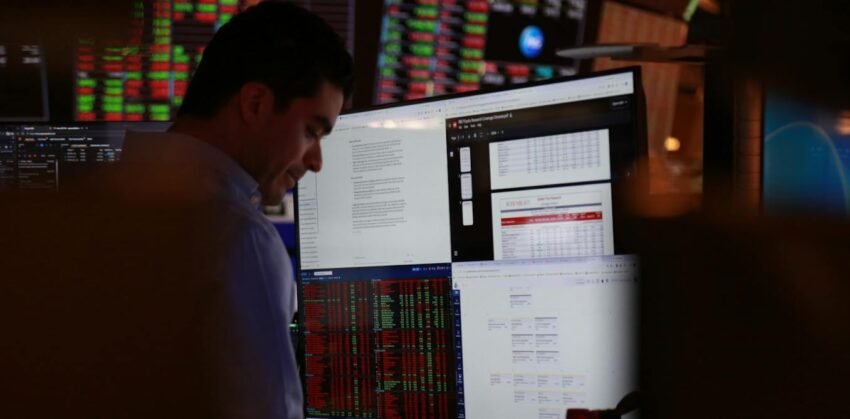
After stock markets, including the tech-heavy NASDAQ, got pummeled on Nov. 20, 2026, many Americans are asking themselves whether the huge bet on artificial intelligence is heading south.
This question has profound implications for retirement savings, given how much these investment accounts are tied to stocks.
The NASDAQ has plunged about 18% since early October and has lost more than US$4 trillion since Nov. 16. The broad-based S&P also took a beating and has now shed all its gains for the year.
As a finance professor and certified financial planner, I can’t tell you whether the bubble has truly burst for good. But I can explain how the default model that most 401(k) plans use works, where it protects you, and what you might consider changing.
Whether AI stocks recover or not, the steps that protect a retirement account are the same: Know what you own, keep the mix of assets in balance, and hold enough in savings and low-risk funds to cover the years when you’ll need it.
Here are some basic facts to guide your planning.
Many Americans are saving on autopilot
Most 401(k) savers hold a target-date fund, which is named for the year of your “target” retirement and is often chosen as a default option by the employer. To understand how the current stock market volatility affects retirement savings, it’s important to first explain how these funds work.
About 55% of U.S. families have a defined contribution retirement account, such as a 401(k) or an individual retirement account. And inside a 401(k), the investing is increasingly done for you.
Six in 10 plans administered by the fund giant Vanguard signed workers up automatically in 2025 when they started a new job. And when those plans set a default investment, 98% of savers choose a target-date fund.
About 60% of the nearly 5 million savers in those plans held a single target-date fund and nothing else. Taken together, target-date funds now hold $4.8 trillion.
Inside each target-date fund is a list of index funds, which are named so because they track a particular market index. Vanguard’s series, the largest, is built mainly from four indices: U.S. stocks, international stocks, U.S. bonds and international bonds. The mix changes the older the saver gets, gradually moving away from high-return, high-risk stocks to safer, lower-yielding bonds.
For example, Vanguard’s 2055 fund was just over 91% stocks at the end of September 2026, reflecting the relative youth of those holding it. That share drops to 16% for savers invested in the 2027 fund, who expect to retire imminently.

Brano on Unsplash
Tech volatility is forcing new questions
That autopilot model is now being tested, starting with Nvidia.
In the span of a week, Nvidia went from riding the AI boom to getting mired in crisis. On Nov. 5, after the U.S. midterm elections raised the prospect of new curbs on AI and data centers, Nvidia shares fell more than 9%, while the broad-based S&P 500 index lost 4.4%.
Then, on Nov. 12, Nvidia announced that CEO Jensen Huang had resigned.
By the end of that week, Nvidia had lost more than $1 trillion in market value within a month.
It’s too early to say whether the AI bubble is over. Some analysts argue that it’s just losing some air rather than bursting. But as tech stocks, especially Nvidia, continue to slide, savers may wonder whether a retirement plan on autopilot should adjust to this fresh volatility.
Target-date funds have significant tech exposure
Target-date funds are marketed as broadly diversified, often holding thousands of stocks, and financial advisers repeated that point after Huang’s exit.
But those stocks aren’t held in equal amounts. Index funds weight companies by market value. So as the value of AI-linked companies soared, their share has grown in the funds most 401(k) savers hold.
And that gets to the question of whether there’s a tech bubble riding on overvalued AI companies.
By the end of 2025, the 10 largest companies made up nearly 41% of the S&P 500, according to RBC Wealth Management. Yet those 10, almost all of which are in tech and AI, were expected to produce only about 32% of the index’s 2025 earnings.
In other words, investors are paying a premium for these shares because they’re expecting great profits later. Bad news can shrink that premium quickly.
Savers should also know that a target-date fund dilutes the concentration of AI stocks, but it doesn’t remove them. At the end of September, the 10 largest companies made up 36% of Vanguard’s total U.S. stock fund, with Nvidia at 7%. A 2055 fund keeps about 55% of its money there. So roughly 20 cents of every dollar was riding on 10 companies, and about 4 cents on Nvidia. That means even a small drop in these stocks can have a big impact on your fund, depending on its asset mix.
And while diversification hedges against one company’s turmoil, it’s less helpful if there’s a broad repricing of tech stocks. Even in Vanguard’s international fund, the four largest holdings are all tied to chipmaking, led by Taiwan Semiconductor, which makes Nvidia’s chips.
Furthermore, diversification doesn’t mean guaranteed protection all the time. In 2008, during the global financial crisis, funds built for people retiring in 2010 lost nearly 24% on average.
What to check now if you own a target-date fund
In principle, savers don’t need to do anything as long as they choose to stay on autopilot until retirement. Fund managers buy and sell assets to stick to the target mix – a practice known as rebalancing.
But rebalancing resets only the broad categories rather than trimming one particular company for growing too large. As Nvidia’s share of the market rose, so did its share of the fund.
For people who hold just one target-date fund, I believe the right response to this month’s news is to leave their 401(k) account alone. The fund has been rebalancing all along, and your stake in any one company is modest.

Towfiqu Barbhuiya on Unsplash, CC BY
But a saver still needs to check three things.
First, consider the year you expect to retire. If you want to move it earlier or later, or want more or less risk, you should choose a fund with a different year.
Second, look at what the fund’s share of stocks is today, which is on the fund’s fact sheet. If you’re 60 and your fund is 60% stocks, a 30% fall in stocks would cut your balance by roughly 18%. If that would derail your retirement plans, you can switch to an earlier-dated fund that holds less in stocks and brings less risk.
Third, if you have other funds, you should review them. About 1 in 4 target-date investors in Vanguard plans hold other funds. If you add a tech fund or an S&P 500 fund, your account is riskier and more concentrated than the label suggests.
What to do if you hold other funds
About 31% of savers in Vanguard plans opt out of target-date funds and choose their own investments, perhaps because they find target-date funds too conservative or their fees too costly. For these investors, and for anyone with old 401(k)s and IRAs, there is more to do.
Start by looking at the fact sheet for each fund, like this one for Vanguard’s S&P 500 index fund, and compare the top holdings. An S&P 500 index fund, a large-cap growth fund and a technology or Nasdaq-tracking fund look like three investments. But in fact you may own the same handful of companies three times.
Next, you should rebalance your holdings according to your plan, not to a prediction. That means returning to the mix of stocks and bonds that you chose in the first place. Trades inside a 401(k) don’t trigger taxes, and many plans offer automatic rebalancing. If yours doesn’t, a simple rule backed by Vanguard research works: review once or twice a year, and rebalance whenever any part of your mix drifts more than about 5 percentage points from your target.
Finally, consider broadening the stocks you own. Morningstar Indexes strategist Dan Lefkovitz has pointed to U.S. value stocks, smaller companies and international stocks as areas with less AI exposure. Your plan may offer funds for each.
None of these makes you immune to losses, and diversifying can mean trailing the hottest part of the market for years. But the pattern can flip quickly: International stocks gained about 29% in 2025, far ahead of the S&P 500’s 16%.
Align your savings to your timeline
How much this month’s news matters depends on when you’ll need the money.
If you’re decades from retirement, a downturn can work in your favor, because every paycheck contribution buys shares at lower prices. Keep contributing and capture your full employer match. My own research with a colleague has found that accounts on systematic investment plans akin to 401(k)s earned better market-adjusted returns than accounts funded with lump sums.
If you’re within 5-10 years of retirement, the bigger danger is what planners call sequence-of-returns risk: A large loss right before or just after you start withdrawing can permanently shrink what your savings can support. A good defense is to hold several years of expected withdrawals in lower-risk assets, such as bonds or money market funds, so you’re never forced to sell stocks after a drop. For retirees, Morningstar’s Christine Benz suggests one to two years of withdrawals in cash and five to eight more in bonds.
What not to do
The costliest mistake is usually the most tempting: selling everything and waiting for the dust to settle.
During the 2008-09 financial crisis, about 117,000 Fidelity 401(k) participants moved entirely out of stocks. Those who stayed out saw their balances grow just 2% by mid-2011, while those who kept some stock exposure saw balances rise 50% on average.
Other moves to avoid include stopping your own 401(k) contributions, chasing whatever theme looks safe this month, and pulling money out early, which can mean taxes, penalties and a locked-in loss.
Last, don’t hand the decision to a chatbot. It will likely give you sound general guidance, such as diversifying and not panic-selling, and that consensus advice is where AI is reliable. But it is weakest on high-stakes questions that turn on your own situation.