
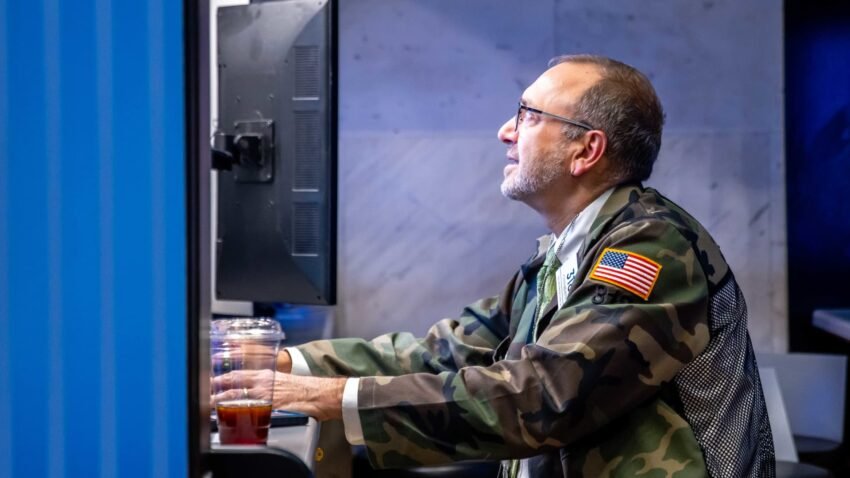
A trader works at the New York Stock Exchange on Oct. 21, 2026.
NYSE
As CoreWeave shares plummet, taking much of the AI complex with it, investors face a simple question: what’s the best way to hedge AI risk?
An ex-Citadel quant might have the answer.
Jasper Zhang is an ex-Citadel Securities quantitative researcher who now leads Hyperbolic. It’s a 50-person financial technology startup building a spot marketplace for tradable GPU computing power, a tool that would allow traders to hedge against a decline in AI demand.
The platform allows investors to buy and sell GPU clusters, the units that power AI compute. This is done through Hyperbolic’s Forge software, which virtually logs into clusters worldwide and makes technical tweaks so that mismatched clusters work better together, allowing traders to not just buy and sell a standardized unit of compute, but also control the underlying GPUs for their own purposes.
Zhang says it’s as good as being in the data center itself, and sees the technology as the first building block of “physically” settled GPU futures, which, upon settlement, would offer contract owners complete control over a cluster with known characteristics. In other words, it would allow investors a new way to hedge against a decline in AI demand by trading the hardware itself.
Currently, GPU architecture varies wildly depending on how they are assembled, leading to various levels of output. Every data center is different. Networking, memory, and security all affect GPU performance. At the same time, financing agreements often prevent builders from sharing prices, meaning a survey-based index may average setup costs while missing outlier expenses.
In the futures world, that’s called “basis risk.” It’s a problem for market-makers to solve, and a void Zhang hopes Hyperbolic can fill.
The 31-year-old Zhang came to America with several Chinese math medals and finished a math doctorate at U.C. Berkeley in just two years before taking a job at Citadel Securities building trading models. Hyperbolic’s head of finance, Hong Chan Kim is a hedge fund veteran, having worked at Point72, Balyasny Asset Management and Citadel LLC, the hedge fund.
Hyperbolic has raised $20 million since its launch in 2022, is in the midst of another funding round, and expects a $150 million annualized run rate by year-end. As of today, the company says it has about 250,000 users and an estimated $200 million worth of annual GPU compute connected to its platform.
Emerging market
Other big players see a similar opportunity in the marketplace for AI hedging tools.
CME Group plans to offer a cash-settled futures product that is tied to GPU pricing maintained by Silicon Data, an index-provider backed by DRW, one of the biggest prop-trading firms in Chicago.
“There’s a ton of demand and capital flowing into this ecosystem so there’s a lot of risk,” Don Wilson, founder and CEO of DRW, said in a call. “Cash futures are a great first building block. There are plenty of electricity futures that are cash-settled, oil futures that are cash-settled, so I think you can start these things either way.”
The CME product is currently under review with the CFTC, but the commission recently extended that review period to November 9th, likely also tying up another futures contract proposed by Intercontinental Exchange and data-provider Ornn, backed by Andreessen Horowitz’s a16z crypto fund.
“Our guess is when the cash-settled futures come out they’re not going to be reflective of what’s going on in reality,” says Hyperbolic’s Kim. “Physical usage is what will tether that connection between the reality and the derivatives.”
The bigger issue is that cash futures are an imperfect hedge for real-world risk. If AI demand hits a wall, AI rent-a-centers like CoreWeave could end up sitting on billions of dollars in AI hardware with little to no way to cash out.
“Indices are a normalized global number,” said Carmen Li, CEO of Silicon data and DRW-backed Compute Exchange, a marketplace for buying and selling GPUs that is also laying groundwork for physically-settled futures. “You get financially hedged, but if you’re looking for procurement, that’s not going to help you.”
What the AI complex needs most – in particular smaller startups that don’t have the capital or credit to risk making big hardware purchases – is a virtual pipeline to physical hardware, contends Zhang.
“CoreWeave’s debt situation would be less concerning if providers had more ways to monetize available GPU capacity during a slowdown, especially when long-term contracts carry thin margins,” said Zhang. “Cash-settled futures can help falling prices, but they do not by themselves put idle GPUs to work.”