
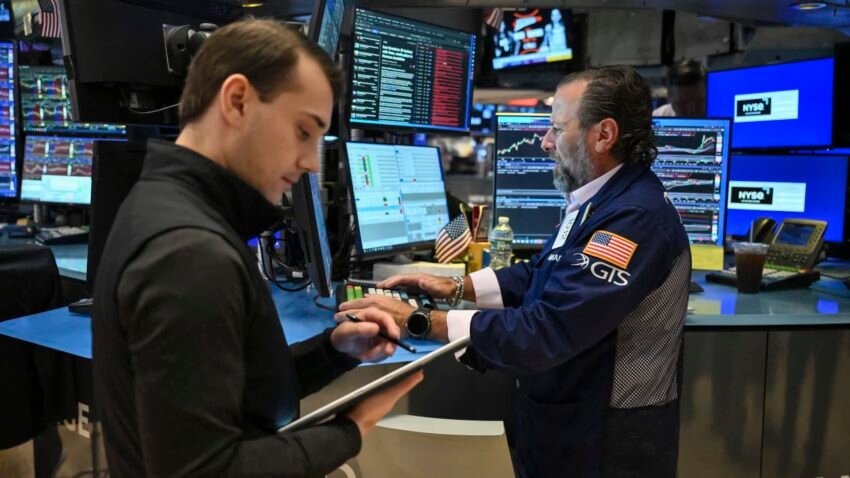
Traders work on the floor of the New York Stock Exchange (NYSE) at the opening bell in New York City on October 19, 2026.
Angela Weiss | Afp | Getty Images
A version of the S&P 500 without AI briefly pulled ahead of the traditional index this year and is now neck-and-neck as investors rotate into other areas of the market.
A proprietary Goldman Sachs index tracking the S&P 500 without stocks classified as “AI enablers” was up 12.4% through Oct. 22, edging ahead of the standard S&P 500’s 12% gain. The Goldman index is now neck-and-neck with the S&P 500 as tech rallied in Monday trading.
Tech and AI-related companies make up about 45% of the S&P 500. That heavy weighting has helped power the index for years, but it’s turned into a liability lately; the S&P 500 tech sector is down about 7% this month while other sectors have held up.
Investors have soured on debt and equity issued by companies like CoreWeave and Oracle. Shares of Meta Platforms sank almost 7% Thursday after it outlined more plans to spend heavily on capex and issue additional shares.
Companies supplying power and equipment for the buildout have been hit hard — names like GE Vernova, Bloom Energy, Vistra and Quanta Services all suffered steep declines during the recent selloff.
Goldman, which launched the measure earlier this year with S&P, uses the S&P 500 as its starting universe and excludes companies perceived to be enablers of AI before applying S&P 500 Index weighting methodology to the remaining universe of companies.
AI trade loses steam
The ex-AI index lagged the S&P 500 for most of the year as investors continued to favor chipmakers, cloud-computing companies and other firms benefiting from heavy AI spending. However, that advantage has been narrowing and it disappeared last week.
Meanwhile, investors are rotating into defensive areas. ETFs like State Street Consumer Staples Select Sector SPDR ETF, State Street Health Select SPDR ETF and State Street Utilities Select Sector SPDR ETF are up 7% to 10% this month. Energy is ahead 10% too, though that’s more related to the war in Iran.
Some analysts recommend sticking with non-AI companies for diversification and protection against more pain in tech. The “AI pendulum has swung back in favor of non-AI exposure over the last two weeks,” Oppenheimer technical analyst Ari Wald said in a note on Oct. 24.
Two industries that Oppenheimer favors now are commercial services and insurance. The firm upgraded those industries to overweight last week, recommending Republic Services, Cintas, Verisk Analytics, Broadridge Financial Solutions, MetLife and Arthur J. Gallagher.
Berkshire Hathaway is also capitalizing on the rotation out of tech. Its Class B shares are up 8% this month, though it’s still lagging behind the S&P 500 this year.
Berkshire owns a wide swath of operating companies, including insurance giant Geico and Burlington Northern Santa Fe railroad. It also has a $364 billion stock portfolio including companies like Apple, Coca-Cola, Alphabet and Bank of America. That diversification may help Berkshire continue to outperform if the tech sector drags down the S&P 500.
Trivector Research sees potential in “non-tech compounders.” Healthcare giant Eli Lilly is one idea. The stock is up 22% on the strength of Lilly’s weight-loss drugs. The company has more in the pipeline, including a next-generation obesity drug that Lilly plans to file for FDA approval early in 2027.
Viking Holdings, a cruise operator, is also proving durable. The company said on its August earnings call that 40% of its river capacity and 60% of its ocean capacity was already booked for 2027. “Based on recent events, we’ve seen our guests have proved to be resilient and are continuing to book 2027 and future seasons,” the company told investors.
Viking stock is up 15% this year but it may still have upside. The average Wall Street target is $109, above recent prices around $82. Barclays recently upgraded the cruise operator to overweight with a $102 target, citing the company’s “compelling risk/reward.”