
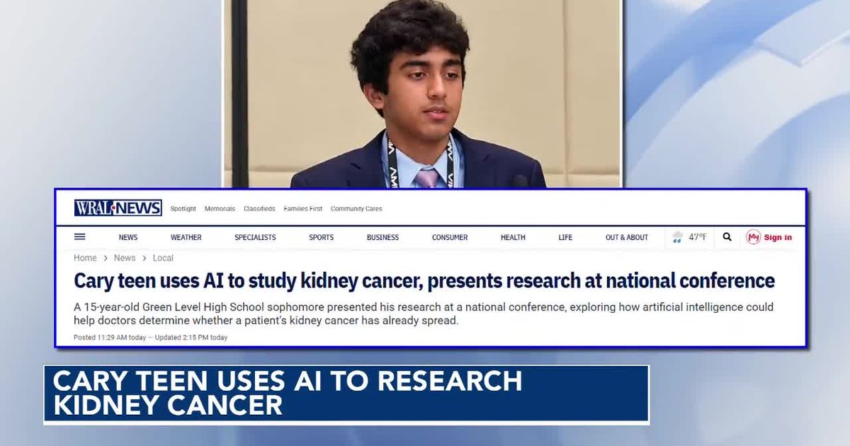
For 15-year-old Krish Senthil, being a high school sophomore means balancing homework with a research project that could one day help doctors caring for kidney cancer patients.
The Green Level High School student traveled to Dallas earlier this month to present his research on artificial intelligence and kidney cancer at the American Medical Informatics Association’s 2026 Annual Symposium.
Senthil was selected through the association’s High School Scholars Program after submitting his research to a committee. On Nov. 9, he presented his findings to medical professionals and researchers at the national conference.
Senthil said his interest in medicine began in middle school, and his research inspiration came from his own family.
“I chose kidney cancer because my dad is a kidney researcher, and both of my parents were involved in the medical field,” Senthil said.
Over the past four to five months, Senthil has been researching how artificial intelligence could help doctors determine the likelihood that a patient’s kidney cancer has already spread to other parts of the body, a process known as metastasis.
His research specifically focuses on patients diagnosed with kidney cancer before the age of 50.
Using artificial intelligence to study kidney cancer
Using information from a national cancer database maintained by the National Cancer Institute, Senthil developed computer models that look for patterns in patient data.
He used information from patients diagnosed between 2004 and 2018 to train his models, then tested them using data from patients diagnosed between 2019 and 2023.
His research found that tumor characteristics, including size, were among the most important factors in predicting whether the cancer had spread.
According to Senthil, when comparing a patient whose kidney cancer had spread with one whose cancer had not, his model ranked the patient with metastatic cancer as higher risk approximately nine out of 10 times.
Senthil hopes research like his could eventually help doctors determine whether a patient needs additional testing, such as a CT scan, based on information doctors already have at the time of diagnosis.
The goal, he said, is to assist doctors, not replace them.
The research uses existing patient data, and his model has not been clinically validated for use in patient care. Additional research would be needed before it could help doctors make medical decisions.
Balancing high school and medical research
For Senthil, attending the national conference was not only a chance to share his research but also to learn from experienced medical professionals and researchers.
“It was super cool because a lot of them had research of their own and they were extremely experienced,” Senthil said.
Back home in Cary, Senthil continues to balance his interest in medical research with the everyday responsibilities of being a high school student.
“I have to balance homework too, so I have quite a bit of homework,” Senthil said.
He said he makes sure his schoolwork remains a priority while finding time to continue his research.
Looking ahead, Senthil hopes to attend medical school. He also wants to continue improving his computer model and potentially expand his research to other cancers.