
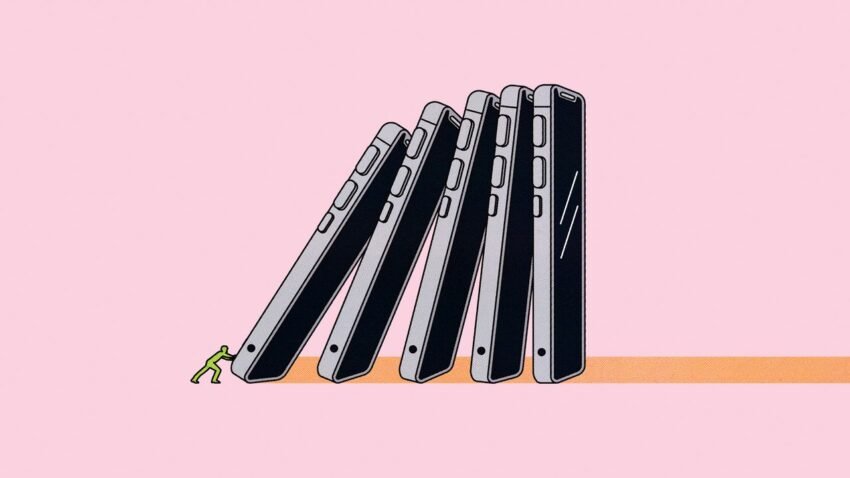
These days, resistance to tech is typically framed in terms of individual choices: if we buy the Brick, limit our children’s screen time, delete the worst apps from our phones, stop doomscrolling, and refuse to use ChatGPT for anything other than the most mundane searches, we will be released from the grasp of Big Tech. Freedom becomes a question of your own will power. In 2022, the Times published a charming story about “Luddite” teens in Brooklyn who met up in Prospect Park once a week to draw, whittle, and read “The Consolation of Philosophy.” The teens, many of them inspired by the D.I.Y. punk scene and Jon Krakauer’s “Into the Wild,” had decided to drop out of digitized life and start noticing the world outside their phones. Like these kids, I usually think about tech resistance in terms of my own attention and that of my family. I worry constantly about whether the iPad is rotting my children’s brains; I celebrate every reduction in my weekly screen-time reports. But I think this individual focus has a lot to do with why we feel so helpless against Big Tech, and I wonder whether those of us who want to free ourselves from our phones might be better off thinking more collectively.
One of the longest-running and most significant ongoing political actions against A.I. has come from nurses, who, since at least the spring of 2024, have been protesting the technology’s incursion into their profession. Their concerns are numerous and rooted in both present practices and future possibilities. This past March, more than two thousand mental-health professionals at the health-care consortium Kaiser Permanente went on a one-day strike over concerns that they would eventually be replaced by artificial intelligence. Four months later, a story in CalMatters detailed new surveillance layers that had been placed on nurses at Kaiser, including an A.I. program that allegedly assessed their empathy and the tone of their voices when they answered calls from patients. Last year, HCA Healthcare, one of the largest hospital providers in the country, released a joint program with Palantir called Timpani, which promised to streamline the scheduling of nurses by using A.I. to spot inefficiencies. This past August, the National Nurses United (N.N.U.) union led a day of nationwide demonstrations against Palantir.
Americans, in general, like nurses and don’t trust A.I. companies, much less Palantir, to make potentially life-saving decisions. And although hospital efficiency measures are nothing new—almost every labor fight in the health-care sector arises out of issues around head count and hours—A.I. represents a different type of invasion. The N.N.U. is not demanding a full removal of A.I. technology from workplaces, or suggesting a return to a time when all scheduling was done by hand and all consultations were aided only by a nurse’s hard-earned experience. Rather, the union is drawing a line at A.I. supremacy in staffing, decision-making, and clinical assessments. “What makes A.I. even more dangerous is the insistence of health-care companies and these billionaires to use it as a technology to override the judgment of nurses, and to override their clinical decision-making,” Puneet Maharaj, the executive director of the N.N.U., told me.
Maharaj said that A.I. has infiltrated many parts of a nurse’s workday. In the past, nurses’ schedules were partly automated but overseen by a human manager, who could be aware of, and responsive to, personal issues. Now schedules are run entirely by A.I., which, according to Maharaj, will always understaff nurses’ posts. When nurses arrive at their shifts, they may be asked to use A.I. tools that listen to their interactions with patients, and A.I. may also be used to evaluate medical records. These programs have been known to make mistakes in their automated assessments. For example, Maharaj said, in the course of describing the details of their day, a patient might mention battling pine needles in yardwork, and an A.I. might mislabel the patient as having an opioid problem. The listening machines also raise real questions about patient privacy. “With A.I., we don’t always know where that information is going and whether it will be protected or not,” Maharaj said. (A.I. phone-monitoring is of particular concern among mental-health professionals. This was another reason for the Kaiser Permanente strike in March.)
The ultimate concern, though, is that A.I. will replace the relationship between nurse and patient and turn medical professionals into meat puppets who do the machine’s bidding. “Maybe you can look at efficiency when you’re looking at widgets,” Maharaj said. “But when you’re talking about patients, and you’re talking about the relationship between a nurse and her patient—that is extremely important, and that is reserved for the judgment of the nurse, and not some technology that is going to override their judgment.”