
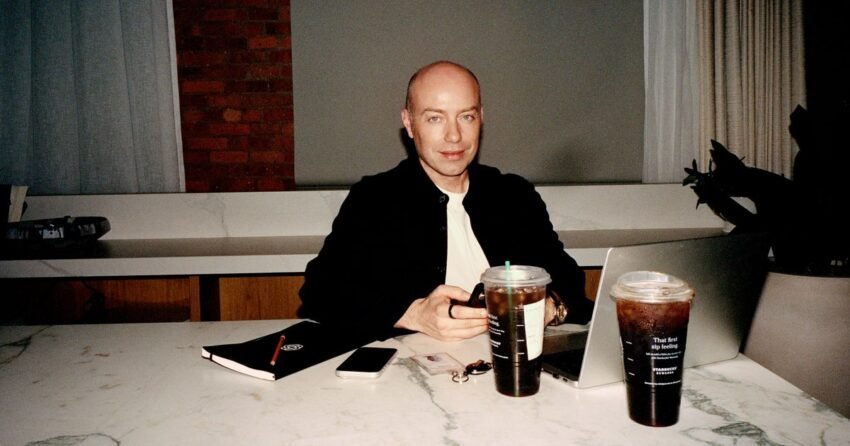

Photo: Danielle Levitt for New York Magazine
In August, news leaked that Gwyneth Paltrow was set to host “a private, off-the-record, alfresco dinner” at her Amagansett home in honor of OpenAI CEO Sam Altman. “I guess summers in the Hamptons just aren’t complete these days without sucking up to our new AI overlords,” Puck’s Matt Belloni, who broke the news, wrote. “Luckily, Gwyneth Paltrow has you covered.” The backlash was vicious — “tone-deaf dumbass,” one X user wrote — and the dinner was postponed.
“God, the internet made it such a bigger thing than it was,” says Charles Porch, who brokered the dinner with Paltrow’s team, as he sips an Arnold Palmer on a crisp afternoon in October outside Sant Ambroeus in Soho. “Gwyneth invests in the space. She does these investor dinners all the time. Sam was coming through town and I was like, ‘Let’s just do this.’”
The Future of AI Will Be Shaped by a Few Dozen People
Altman had hired Porch in 2025 to do for OpenAI what he had done so successfully for Instagram for more than a decade: persuade famous people in Hollywood and beyond to use and partner with the platform and help the tech company be culturally relevant. The freak-out over Paltrow’s dinner reflected how much public sentiment toward big tech had shifted since Porch’s Instagram days, when Anna Wintour hosted the same kind of event for its CEO at the time, Kevin Systrom. I ask him if it made him rethink the playbook. “It makes it look like that’s the strategy, and it’s not the strategy. That was, like, a dinner,” Porch says. “But I know those dinners are effective because I see it. We did the dinner eventually, and it was great.” It took place at the apartment of an AI enthusiast at the end of September in New York.
Everyone above a certain income bracket seems to know Charles Porch, but few can tell you what exactly he does. He showed up in Los Angeles in his grandmother’s Honda Accord wagon when he was 20 and spent the next two decades cultivating a formidable network of celebrities and influencers. “He took one step at a time very carefully, never burned a single bridge, never spoke out of turn, never took advantage of an opportunity in the wrong way,” says Erin Foster, the well-connected daughter of music producer David Foster, who met Porch when they were both underlings at Warner Bros. Records.
“I’m not a business-development guy or the brand guy. I’m the relationships person that’s bringing everyone along on new tech,” says Porch, 45, a self-described “tech optimist” who has long been comfortable in the gray area between the personal and the professional. “There’s a strategy around making friends.”
When he arrived in New York just before the pandemic, few seemed to notice. For those who either didn’t know or didn’t care about what was going on in Menlo Park in the early 2010s, the first time they heard of Porch was likely after his wedding to the billionaire’s scion Robert Denning in 2025, three days of Parisian opulence shared with Jerry and Jessica Seinfeld, Mariska Hargitay, Antony Blinken, Harry Styles (with whom he shares a godchild), Nicky Hilton Rothschild, Darren Walker, Jenna Lyons, and various European aristocrats. After that of Jeff Bezos and Lauren Sánchez Bezos, it turned out to be the ritziest wedding of the summer. Suddenly, he and Denning were everywhere, a power-gay couple imbuing the fabric of New York society, at every gala and fundraiser and opening. The swirl of Porch’s life plays out on his Instagram Stories: courtside at the Knicks’ season opener, Hawaii for Jen Meyer’s star-studded wedding, Paris to see Céline Dion with Reese Witherspoon and Karlie Kloss.
In the process of connecting entertainment and tech, he has found himself at the center of several overlapping circles of power — and become a character in his own right. “I know, scary,” he says when I point this out. “He is really good at putting a room together, and now he is of the room,” says someone who worked with him. “He was someone who understood the room before he was part of the Establishment.”
It’s not hard to see why OpenAI would want Porch on its side. “It’s funny: I think everyone wants to hate Open AI and everyone wants to love Charles Porch,” says podcaster Nayeema Raza. “That’s probably the value for Sam.”
Porch’s job was never going to be easy. Why would artists and other creative types want to plug something that threatens to replace them? “The full-throated endorsement of AI is probably the biggest third-rail issue in Hollywood right now. And people are terrified,” says a media executive. Headlines about AI in recent months have generated panic about not just job displacement and copyright infringement but also OpenAI agents going rogue and threatening to take down the entire internet. The evil of the tech industry is the subject of several of the year’s biggest films — made by precisely the industry Porch is trying to court. “Charles can get them to sit down and listen to Sam Altman lay out his vision. But if the vision is ‘I’m going to destroy your industry,’ it doesn’t really matter,” says one of Porch’s former colleagues.
“I’m trying to pinpoint ways and moments where AI can show up in culture in a good way,” says Porch, who, with his wide ice-blue eyes, perfectly smooth head, and perma-smile, looks a bit like how AI would render a human. “What I see every day is that people are externally anti-AI but completely in the closet on how they’re using it. It’s almost like they’re at an AI protest in the morning and then a meeting with me in the afternoon. You know what it reminds me of? The early days of GLP-1’s, when it was like, This is kind of shameful; you’re cheating. But then everyone’s like, Wait, this thing’s incredible.”

Photo: Danielle Levitt for New York Magazine
Porch grew up in Charleston, South Carolina. He had a French mother and an Alabamian father and a severely disabled sister. “I was always kind of behind the scenes, taking care of my sister and making sure everyone was comfortable,” he says. “Because my sister couldn’t speak, people would be strange around her. And I wanted everyone to feel good, so I was all about setting the temperature. This caretaker thing is just innate in me.” He spent middle school at a boys’-choir boarding school in Princeton, New Jersey. “We’d have school on the bus, and we’d tour the world and sing religious music,” says Porch, noting he performed at Carnegie Hall several times as a child. He finished high school in Monterey, California, and after graduating from McGill University in 2002, he drove to Los Angeles.
In some ways, Porch has Craigslist to thank for his good fortune, because the landlady of the apartment he found on the site got him an internship in the marketing department of Warner Bros. Records, where he met Foster. “And then, all of a sudden, I was at Kate Hudson’s Halloween party.”
“When I was bringing him into my world, which was more industry forward and had sort of celebrity access points, I found that people were always drawn to Charles,” says Foster, “because he didn’t want anything from anyone” and he “didn’t seem like he himself was trying to be the talent.” Porch “became a person people felt safe having around, whether that be in their work life or in a friend group,” adds Foster. “He never came across as someone who was a user or someone who was going to speak out of turn or share private information.”
Four years later, in 2008, Porch left to run strategic relationships at Ning, the now-defunct social-networking start-up co-founded by Marc Andreessen. Through that job, he met Randi Zuckerberg, Mark’s sister. Says Porch, “She called me in 2010 and said, ‘Can you move to Palo Alto in a week? I need help talking to L.A. and translating.’” At Facebook, Porch’s job was convincing people to use Facebook Pages, which were good for brands and businesses but less useful to celebrities. “They weren’t going to buy ads. They didn’t have those needs,” he says. Meanwhile, celebrities were starting to join Twitter: “Then I woke up to the fact that we bought Instagram and I was like, Aha! I cornered Kevin Systrom in a kitchen at work and said, ‘I think we can move pop culture from Twitter to Instagram.’ And he said, ‘Who are you?’ I was like, ‘My name is Charles. This is what I do. I’m going to set up a desk in the Instagram area and do this pro bono. If you hate what I’m doing, I will scurry off to Facebook.’”
Porch’s mission was to teach celebrities that the app was not just a place to post your grainy breakfast photos but a marketing platform that offered direct fan connection and full message control. “My thing was ‘Why does this movie studio or record label own your entire fan base? You should own it and take it with you wherever you want and build whatever business you want on top of it,’” he says. Meanwhile, digital natives like fashion bloggers were moving to the app. “That’s really where the influencer started to come from,” he adds.
At the end of 2013, Beyoncé’s team approached Porch about a surprise album release. “She doesn’t want to do press; she doesn’t want to tell anyone that it’s coming. She just wants to come off the mountain and deliver an album,” Porch recalls her team saying. “I don’t even think Sony, her label, knew how she was going to launch it.” She did so on Instagram, writing “Surprise!” to her more than 8 million followers as the full album appeared on iTunes. The successful rollout was proof that artists could sidestep the traditional press apparatus and other industry conventions if they had a strong enough connection with their fans. It was a flex of social media’s power.
In the fall of 2014, the cover of Vogue’s September issue featured the nine hottest models of the moment, all of whom had gained large followings on social media. “Instagirls!” the cover line read. That was “the moment I really knew we’d tipped something in culture,” says Porch.
“He came into tech at a time when they recognized they could become a supplemental engine to power in culture,” says a tech adviser. “He, as a result, controlled massive marketing budgets to deploy that, and what that looked like was partnerships — funding parties, events.” Porch came to serve as a kind of social fixer for Instagram co-founders Systrom and Mike Krieger. “I’m like, ‘Great, you’re gonna come to L.A.? I’m going to have Guy Oseary throw a cocktail party for you where you’re gonna tell Ariana Grande about Instagram and why it’s valuable,’” Porch recalls. “We’re this new service. We’re trying to convince people to use it. I want them to be able to picture the people that are leading it because otherwise they think it’s going to be a bunch of robots that are controlling things behind the scenes.”
When Adam Mosseri became head of Instagram a few years later, Porch ran the playbook back, getting his friend Jen Meyer, the jewelry designer who was then married to Tobey Maguire, to host a cocktail party for him at her house. Some of the Kardashians came. Porch became a trusted source for Mosseri on all things related to public figures and influencers and showed him the value of, say, Instagram sponsoring the Met Gala. “Charles is a generational talent at managing up,” a former colleague of his at Facebook says. There are lots of people today who play this liaison role at tech companies, but Porch was a pioneer in the field, helping craft a template that Meta still follows. In 2015, he recruited Eva Chen, who, two years earlier, had been hand-picked by Wintour to lead Lucky magazine; she is now director of Instagram’s fashion partnerships, one of several industry-focused subsections Porch created. “These are not socially gifted people, so if you have any social skills, you’re ahead,” says a former colleague of Porch’s at Meta. “Technical engineers building products and Hollywood actors speak completely different languages. So for Charles to be able to explain them to each other in plain terms and not make either one feel stupid — he’s very graceful in his diplomacy.”
There was, of course, mutual benefit to these relationships. Porch’s greatest skill, perhaps, is the fact that many around him tend to think otherwise. “You don’t even know you’re talking about work until it’s over. It’s almost like you leave the table and you’re like, Oh,” says actress and influencer Dylan Mulvaney. “I think he’s kind of a seed planter. The rest of his team are the ones executing in inbox and doing some of the heavier lifting, but he is so good at making you feel like you want to be a part of something.” And, Mulvaney adds, “he’s fun. That’s the other thing. He’s kind of the — I don’t want to say ‘life of the party.’ I want to say ‘a really good addition to the party.’”
When Porch moved to New York in 2019, he was approaching 40 and ready for a fresh start. Nine years in San Francisco and the city had never quite become home, in part because Porch traveled every weekend, most often to L.A., where he would crash at Foster’s. He wanted more of a community and, after years of singledom, a partner. Also, Wintour told him to. “We were both at a wedding, and I get on the flight back — it was somewhere in the Caribbean — and my seatmate is Anna Wintour,” Porch recalls. They knew each other only distantly through Instagram, but they talked the whole way home. “She’s like, ‘Charles, if you want to do culture, you need to move to New York.’ And I was like, ‘Well, if you say so.’” He bought a palatial apartment in an old townhouse in the West Village and began a yearslong renovation, documenting it every step of the way on Instagram, though he would end up living in the completed project for a mere six weeks. Because by then, he’d met Robert Denning.
Porch has seemingly always enjoyed proximity to power, not the public display of it. Denning, a philanthropist whose late father was one of the founding members of the private-equity firm General Atlantic, enjoys both. His Instagram is a catalogue of famous people he has met and events he has attended. But he is also an entertainer, enrapturing dinner tables with his eclectic interests (aviation, for one) and hot takes. “Charles is such a professional, buttoned-up guy. He’s very loyal, he’s very thoughtful, but he’s not, like, Let loose and party. He’s almost got a work vibe, even socially,” says a close friend of Porch’s. “When we all met Robert, we thought, This is amazing, because Robert is not a filtered, edited guy. We were all just so happy for Charles that he could have that joy of life and the extravagance.”
Denning first heard of Porch on a group chat with a bunch of gay men from Stanford business school. “I’m a reject of one of his friends,” Porch tells me. One person in the chat wrote that he’d been told to go on a date with Porch — and he followed this announcement with multiple vomit emoji. Denning looked up Porch to find him chatting with Gayle King on CBS This Morning about onboarding the pope to Instagram. Says Porch, “He’s like, ‘I think he’s cute. Can I go out with him?’ The friend says ‘no.’ So then Robert’s like, ‘Now I have to go on this date.’”
Denning went on Instagram and found a mutual follower he knew from business school and Porch knew through Randi Zuckerberg. “And he DMs his friend and says, ‘Becca, I’m sorry for not RSVP-ing to your wedding ten years ago or acknowledging your two children, but I need you to do something for me,’” Porch says. “And she writes back right away and she’s like, ‘I don’t know him that well, but I’ll try.’” The next day, Denning and Porch got drinks at Temple Bar. “Becca had a place of honor at our wedding, but we both barely know her,” says Porch.
Denning had just moved to New York. He was recently sober and, following the fire sale of his luxury-eyewear start-up, trying to figure out what to do next. His father, Steve Denning, sat on several boards; as Steve’s health declined, Robert started filling in for him, and his philanthropic career took off from there. In 2024, Denning became the then-youngest member of the board of the Metropolitan Museum of Art. “He’s great on a board,” Porch says.
By December 2022, they had made the relationship Instagram official, hard-launching with a photo in front of Joe Biden’s White House (Denning is a big Democratic donor). And the following October, they were engaged. Denning thought they were going to a dinner at the Met in honor of an exhibit opening, but really they had the entire museum to themselves. Porch got down on one knee in the Greek and Roman wing.
In the spring of 2025, Amy Griffin, Foster and her two sisters, Naomi Gleit, and Meyer threw Porch a Charlie’s Angels–themed bachelor party at the ultraluxury Amangiri resort, all of which was documented on Instagram. For the wedding, Porch and Denning hosted roughly 400 guests at Le Bristol, renting out the luxury hotel for the first time in its 100-year history. They paid for everyone’s room as well as their room service. Night one was a party in the hotel courtyard; night two was the ceremony, held in the sculpture garden of the Rodin Museum. Ten minutes before the ceremony was to begin, the sky opened to a downpour, only to clear suddenly to an amber light. First came the bridal party, a group of six children — godchildren and spawn of close friends — outfitted by Thom Browne in seersucker suits, ties, and knee socks (Porch’s idea). Then came the grooms, who walked down the aisle to the Jurassic Park theme (Denning’s idea). Foster officiated. Barbara Bush gave the first reading, Griffin the last. The couple encouraged women to repurpose their old wedding dresses for the event; seemingly the only one who did was Real Housewife Carole Radziwill.
Then it was off to the Hôtel de la Marine for a reception and dinner. Before the guests sat down, Denning gave a vaguely political speech calling attention to the fact that this was a gay wedding and urging the roomful of people with lots of resources and power to take care of those whose rights they were celebrating. At the after-party, French drag queen Nicky Doll performed. The fairy-tale weekend ended with a black-tie affair at Château de Villette on the last Saturday of summer with the couple in custom midnight-blue Hermès tuxedos.
The pair have been well received in New York in part because they’re so happy to be here. “Anna loved him because she could invite him to any dinner party and sit him next to any annoying or difficult person and he knew how to show up, lift the conversation, and never complain,” one fashion editor recalls of Porch. “He’s just very kind and normal and unassuming,” says Wes Gordon, the creative director of Carolina Herrera and a friend of Porch’s. “It’s easy to forget he was a very senior person at Meta and now OpenAI.”
Porch and Denning are tight with theater producers, fashion designers, art curators, and socialites such as Lauren Santo Domingo, Jenna Lyons, and Derek Blasberg. “They were two separately quiet people in different realms and then when they came together, they started making a splash,” says one journalist. “A lot of people will make names for themselves in San Francisco and L.A. and then they come to New York and it’s like being shot out of a cannon into other worlds.”
A couple of months after the wedding, Porch was at Instagram HQ in Menlo Park when Altman’s call came through. They discussed how “everyone’s talking about AI and productivity and that’s great, but no one’s talking about AI and culture,” Porch recalls. “And those two things are going to come together, and culture is run by all these creative industries, and question mark on what that’s going to look like.”
There were more conversations, with Altman and Fidji Simo, Altman’s then-No. 2, with whom Porch worked for more than a decade at Meta. “I think what Fidji really realized is there was an enterprise-and-sales arm that was being built for it, but there wasn’t anyone to work on the talent side,” Porch tells me. “That is where there was an obvious opening for me to come in.” Still, he had just gotten married, and he politely declined. When Simo came calling again in January, Porch was more receptive. “It was like, ‘New Year, new me.’ Time to jump to the next frontier,” he says. “Sam, I feel, is the same person I met socially years ago in San Francisco. And it’s kind of fun to work for a gay guy.”
He started in March, spending his first few months on a listening tour, mostly in New York and L.A., meeting with everyone from the Council of Fashion Designers of America to HBO showrunners. “I ran around and went to a bunch of people I knew would have strong opinions on it, good or bad,” says Porch. He went to the Cannes Film Festival, meeting with directors and hearing their feedback on the technology. “There was way more openness because directors have been using AI forever,” says Porch. He also went to San Francisco — “a lot,” he says, stressing the t — “to bond with the product folks and the researchers and try to get a sense of what they’re really interested in. I don’t have that many mathematicians on speed dial.”
Then he brought people together for intimate events — “just a lot of relationship building for the company,” says Porch. At Paris Fashion Week, he hosted a dinner at Sushi Park with Joopiter, Pharrell Williams’s digital-first auction house, for various French creators. “It wasn’t heavy programming, and it wasn’t branded,” Porch says. “It was just a collab with Joopiter to get people talking.” He has also hosted dinners for TBPN, the daily tech-industry podcast OpenAI acquired in April to help bolster positive conversation around AI. The first TBPN dinner was held in L.A. and attended by the Foster sisters, Monica Lewinsky, Crazy Rich Asians director John Chu, and manager turned tech-investor Guy Oseary. They replicated it in New York a few months later at the downtown restaurant Kiko, where TBPN president Dylan Abruscato was seated next to SNL’s Chloe Fineman and Kareem Rahma of “Subway Takes.” Vogue head of editorial content Chloe Malle and Vanity Fair editorial director Mark Guiducci were also in attendance. “He has been very instrumental in helping TBPN deepen our relationships with Condé Nast,” says Abruscato.
A few days before our interview, I attended one such event, a dinner Porch co-hosted at the subterranean members’ club Chez Margaux. In celebration of influencer Serena Kerrigan’s new book, the gathering was attended by a mix of podcasters, creators, and Real Housewives, but, I noted to Porch, I didn’t hear any discussion about AI. “That was a personal dinner, just so you understand. My personal and professional kind of blend,” he says. “But what’ll happen from that dinner is Serena’s probably going to call me in two months and be like, ‘Wait, I have this idea. I love Chat for this. Do you wanna do this thing with me?’ So there’s a nice cadence of how that happens. But also, you know, there were three Real Housewives there. If an AI model comes up on the show, it might be Chat because we have this nice drumbeat. This is what I’ve been trying to explain to folks: It’s not about deals; it’s about relationships.”
Still, it’s hard to say what exactly is supposed to result from this strategy. The idea appears to be that all this social lubrication will pay off and that Altman and his ilk will one day be seen less as freakish world destroyers than as parts of a broader mosaic of American celebrity. Familiarity, even at an elite level, tends to trickle down.
So far, though, things look decisively less glamorous than they did at Instagram. Aside from Lionel Messi’s ChatGPT World Cup partnership, the most prominent celebrities working with the company have been rookie NFL quarterback Fernando Mendoza, who recently spoke to GQ about using ChatGPT for meal planning and nutrition, and designer Francesco Risso, who discussed the role of Astra in his creative process in an OpenAI-sponsored video on Vogue’s YouTube channel. “There might come a day when I get a call from Charles about doing something, and I’ll navigate that in real time, but I recognize this brand has very bad PR right now,” says one creative professional. They add, “If you’re someone who doesn’t like where things are headed, anyone affiliated with this world is going to be seen as part of the problem.”
“When Kevin Systrom or Adam Mosseri were having events with celebrities, people wanted their leverage to help them grow their account, grow their influence,” says one media executive. Instagram is inherently about marketing yourself; OpenAI’s main product isn’t yet public facing. “Aligning yourself with OpenAI, every star has to ask, ‘What’s in it for me?’ — except for potentially a big check and a lot of blowback,” says the media executive. Skepticism around technology has only grown since Hollywood cashed in on the NFT and crypto crazes, resulting in embarrassing commercials and promotions that blew up in many high-profile faces. And the threat AI poses to cultural fields also seems to be putting a higher premium on good old-fashioned human creativity and originality. “I don’t care how cute you make Waymo look: This autonomous-AI-powered life is not warm and cuddly,” says the media executive. “There’s not a cool factor.”
At the same time, many in the entertainment industry are desperate. “Right now in Hollywood, only the top people are working,” the executive says. “It’s why Robert Pattinson is in every project or why Nicole Kidman is literally in everything you watch on TV. The next tier down is not getting jobs.” According to Porch, when he joined OpenAI, there was a backlog of inquiries from various celebrities looking for an endorsement deal, production studios wanting to become more AI focused, fashion houses trying to figure out e-commerce, and sports teams and leagues looking to integrate more AI. It’s possible that we will look back at this moment as we do at musicians who wouldn’t give their songs to iTunes. “Now, it’s like, ‘I can’t believe you would have turned down the check,’” one journalist says.
Some people roll their eyes at Porch, dismissing him as someone whose job is to be friends with famous people and questioning whether he has any expertise at all. “He’s a super-wily leverager of social relationships, but it helps when you have multimillion-dollar marketing budgets to get people what they want,” says a tech adviser. Another media executive sees what Porch has done as a kind of surfing: You choose your wave, start paddling at the right time, and rise at the perfect moment. It’d be fair to say Porch is a good surfer, they note. And now people are watching to see if he can stay up. “He sits in the middle of the convergence of media, culture, and tech, but he’s also right at the changing of the tide,” says the tech adviser, noting that Porch embodies a certain older-millennial brand that may be going out of fashion. “How much longer does someone like him maintain clout when it may be based on an outdated model of how those worlds interact?”
Porch insists he’s not worried. “What I keep coming back to is, I think, the usefulness of AI,” he says. “What it’s transforming for people is undeniable. And the more conversations I have, I just — I feel it coming, people being able to talk about it more.” He adds, “Everything moves faster in AI.”