
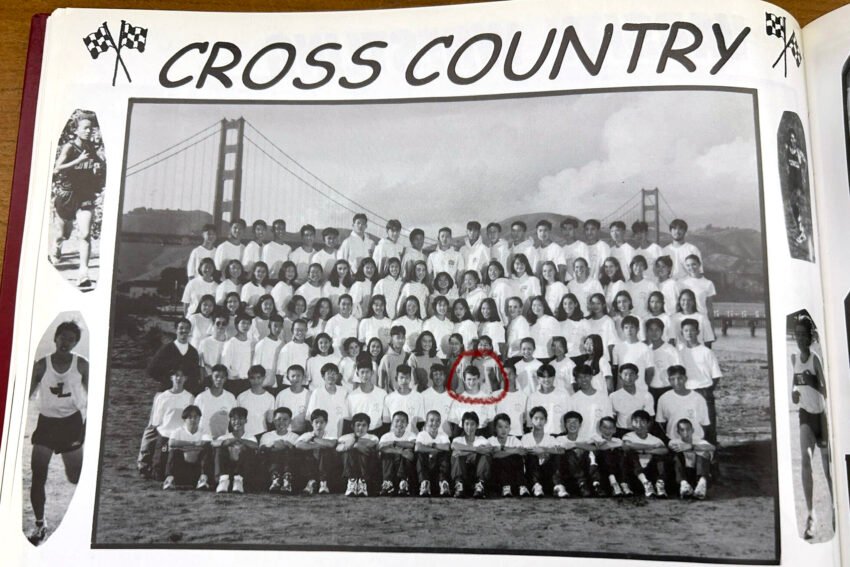

The 1997-1998 cross-country team at Lowell High School. Dario Amodei, the founder of AI company Anthropic, is circled in red.

Dario Amodei had no interest in joining the burgeoning tech boom taking hold of San Francisco.
It was the late 1990s, and he was still a teenager, an elite student at the academically competitive Lowell High School. He was more interested in tackling complex science problems, and had his sights set on a career in research.
The idea of founding a company? Boring. Becoming a multibillionaire alongside his younger sister, Daniela, by building a company at the center of the artificial intelligence revolution? Laughable.
Article continues below this ad
“I was interested in being a scientist,” he said in a 2025 technology podcast. “I was interested in physics and math.”
The Amodei siblings grew up in San Francisco’s Mission neighborhood, about two miles from the current downtown headquarters of Anthropic. Their company is now on the brink of an IPO with a potential valuation of more than $2 trillion. Dario, as CEO, and Daniela, as president, are each expected to become overnight billionaires, and have vowed to give away most of their net worth.
But as their technology reshapes work, education and the city that raised them, their story also provides a glimpse into one of the city’s most celebrated and debated public institutions: Lowell, from which Dario graduated in 2001, and Daniela in 2006.
Likewise, their experience at Lowell sheds light on them. While starting a company may not have been in the sights of a high school-aged Dario, his senior yearbook quote, from science fiction writer and biochemistry professor Isaac Asimov, now carries an added resonance amid debates over the risks of AI: “Never let your sense of morals get in the way of doing what’s right.”

Dario Amodei, CEO & Co-Founder of Anthropic, attends the Annual Meeting of World Economic Forum in Davos, Switzerland in 2025.
Neither Dario nor Daniela responded to interview requests.
Article continues below this ad
Admission to Lowell, founded in 1856 and located in the Lakeshore neighborhood since 1962, had long been highly competitive. It became even harder for many students to get in just before Dario enrolled, as the overcrowded school changed its admissions rules. In 1996, 1,928 students applied for about 600 spots.
But once there, he was known as a high achiever even within the school’s academically ambitious environment. Former classmates noted that he took math classes at colleges off campus, since he passed high school-level math by freshman year.
“In a class of 600 students, he was the only person I knew who did that,” Kate Lazarus, who also graduated in the class of 2001, told the Chronicle.
His Advanced Placement Physics teacher, Richard Shapiro, remembers Dario well.
“He was one of the top students I’ve ever had, in that handful of top students,” he said.
Article continues below this ad
Dario loved physics and math, the retired Lowell teacher said, and would dive deep into a difficult problem without regard for the time or energy it took to solve it.
“He was always able to solve it,” Shapiro said. “He wouldn’t give up.”

Lowell High School, known for its competitive academics, helped shape Dario and Daniela Amodei.
While Shapiro taught a lot of smart kids over his 30 years at Lowell, “there’s ordinary smart and there’s extremely, super bright kids,” Shapiro said. Dario “was in that super bright category.”
But there was one anecdote about his former student that still puzzles the teacher. During the Y2K global panic over whether computers would work on Jan. 1, 2000 given a glitch in the calendar they used, Dario was “literally upset and worried about it.”
Article continues below this ad
“I never understood. Yeah a lot of things will stop working for a few days, it will be a pain in the ass, but who cares?” he said of his own thinking. “I wasn’t in the end of the world camp, and Dario was. I thought that was curious.”
Shapiro feels similarly about AI and is proud of his former student, though he wouldn’t have guessed he’d start a company.
“I’m excited about the notion,” he said.
The siblings’ parents, Elena Engel and Riccardo Amodei, moved to the city in the ’70s, Daniela said on a business leadership podcast. Their father, an Italian immigrant, was a leather craftsman, and their mother, a Jewish American from Chicago, managed building projects for libraries.
In the podcast, Dario described the San Francisco of his childhood as one that “had not really gentrified yet.” Daniela described taking public transit — the 9 Bruno to the M Oceanview — to get to Lowell.
Article continues below this ad
At the time, Yahoo! was the king of search engines, and instead of smartphones, some students were still carrying around pagers. Computer science was a relatively new offering at Lowell, and the student newspaper had just gotten a web page.

Dario Amodei, founder of AI company Anthropic, in the 1998 Lowell High School yearbook, his freshman year. Amodei is in the top row, third from the right.
Danielle Echeverria/S.F. ChronicleLowell students were interested in a range of disciplines, and the school encouraged them to chase those, whether it was law or medicine or — as Dario would end up doing — pursuing a Ph.D. at Princeton University in biophysics and computational neuroscience.
“Lowell is a great environment for academically inclined students like Dario,” Lazarus said. With a wide variety of course offerings, it was “a bit of a choose your own adventure” academic experience.
Aside from the college math classes, Dario was a track and cross-country runner and competed on the school’s academic decathlon team. His track and cross-country coach, Andy Leong, described him as a dedicated student-athlete, particularly at a school where the student role often overtakes the athlete one.
“Lowell is an academic school, and the kids sometimes try to do too much,” he said. While other runners would disappear from practice when the academic pressure picked up, Leong said Amodei consistently showed up.
“Despite his academic workload, he always came to practice,” Leong said.
Jin Daikoku, one of Dario’s cross-country and track teammates, said that the school’s high-pressure environment “didn’t stress” Dario in the way that it did other students. Instead, he seemed genuinely obsessed with learning — and numbers in particular. Daikoku, who also went to preschool with Dario at Lakeside Presbyterian near Stonestown, said there was even a rumor he could do multiplication by kindergarten.
“He was certainly a genius in that sense,” Daikoku said. “He was passionate.”
Though he was widely recognized as a highly gifted student, Dario wasn’t the kind of introverted kid with his head perpetually in the clouds, those who knew him said. With his cross-country teammates, he would pass the time playing strategy-based card and board games like Settlers of Catan, said classmate Brian Quan. Quan was also on the cross-country, track and academic decathlon teams with Dario, in which they would compete in 10 categories, including a range of academics as well as public speaking and essay writing.
“He was pretty regular for Lowell,” Quan said with a chuckle. “I wouldn’t say he was any more awkward than any of the high achievers.”
Still, when Anthropic burst onto the scene, some who knew him weren’t surprised. Dario was widely expected to be a high achiever — his senior yearbook superlative was “Most Likely to Kick Some Ass.”
“It gets around the group chats when anyone from Lowell starts to make a name for themselves,” Quan said.

Dario Amodei (far right), the founder of Anthropic, with his cross-country teammates his senior year at Lowell High School, the 2000-2001 school year.
The affiliation with Lowell has been a source of pride for some alumni. “The Amodei siblings join a long line of tech trailblazers who are Lowell graduates,” said John Trasvina, vice president of the Lowell Alumni Association. Others include Bill Hewlett, who cofounded Hewlett-Packard, and physicist Albert Michelson, America’s first Nobel Prize winner.
But the technology created and sold by the Amodeis’ company is frightening to many, and has the potential to transform their hometown as well as every corner of the world. In addition to the inordinate amount of money Anthropic is likely to generate in its upcoming IPO, the technology itself is changing the way people work, learn and even think.
“With the Amodeis in the spotlight right now, it’s a reminder of the heady responsibility, to nurture and guide the kind of students who will one day transform the way we all live,” said Lowell Principal Jan Bautista. Bautista also graduated from Lowell in 2004, in between the Amodei siblings, but didn’t know them.
Even as Anthropic and the Amodeis fashion themselves as the voice of reason in the breakneck pace of AI development, pushing for more safeguards and regulations, critics are pushing back, fueled by examples of AI run amok.
At San Francisco schools, parents have grown louder in their opposition to screen time and the use of artificial intelligence in learning. More than 1,100 parents, teachers and others have signed a petition urging the city’s school district to restrict all screen time and AI tools, including disabling chatbots and search engines fueled by the technology on all student devices. The grassroots group Tech in Check also wants city schools to stop using AI programs to teach core skills in elementary schools.
AI wealth is warping the city as well, with highly paid workers pushing up housing costs.

Anthropic co-founder and president Daniela Amodei stands for a portrait at her company’s San Francisco headquarters on Friday, May 22, 2026.
Daniela acknowledged the tension between the San Franciscans she grew up with and the tech waves, noting on the podcast that there’s an attitude that “tech folks came in and they ruined everything.” But she thinks that tension is “healthy” for the companies, like her own, transforming the city.
“There’s accountability that the non-tech residents of San Francisco put on the technology companies that I don’t necessarily think is bad.”
At Lowell, junior Bruno Parker-Tam has embraced the technology, participating in the school’s new AI club, while also serving on the high school’s committee tasked with devising the school’s policy for AI use.
“I’m most concerned about people using AI to replace their own thinking, their critical thinking and their creativity,” he said. But he is also hopeful, he went on. “I feel like for every big technical innovation there is always criticism in the beginning.”
That two Lowell alumni are behind Anthropic is “amazing,” he said.
He met Daniela at a conference, the sense of meeting a celebrity quickly overshadowed by their Lowell connection, and has asked her to come speak to the school’s AI club.
But Parker-Tam said he wasn’t too surprised the Amodei siblings graduated from Lowell, where proving yourself and finding your passion are intertwined.
“Lowell has definitely fostered a competitive nature in me. I love it honestly,” he said. “You can be whoever you want at Lowell.”
And after Lowell, if Dario Amodei is any indication, you can change your mind and then change the world.