
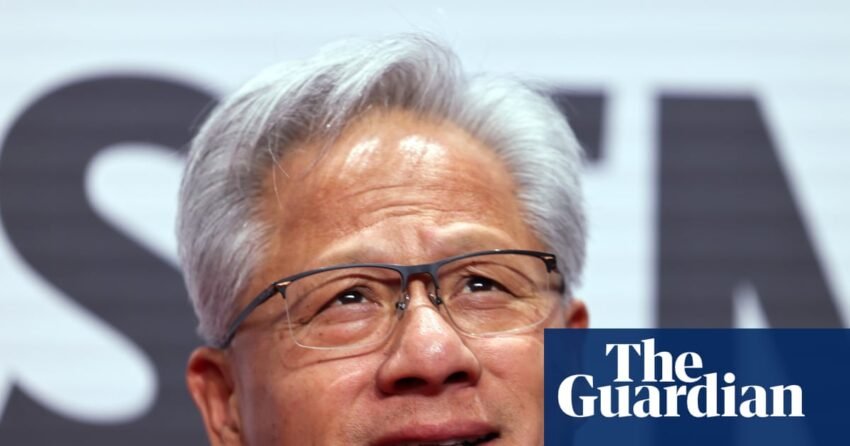
Nvidia has reinstated Jensen Huang as chief executive after Donald Trump directly intervened with the US AI chipmaker’s board of directors, in a stunning reversal of the tech billionaire’s downfall.
Speaking on Monday shortly after Nvidia’s surprise announcement that Huang had been restored to the top job – less than two weeks after he resigned – Trump said that he had “convinced” the board to do it. “I made the deal,” he told CNBC. Huang had resigned after reports of extramarital affairs, including with an alleged Chinese spy and two Nvidia employees.
“It’s very exciting news. I felt very strongly that he should come back,” the US president said.
Nvidia shares surged on the news of Huang’s return, jumping 33% and adding more than $1tn (£764bn) to the company’s market value in New York on Monday, while Trump, who had persistently called for Huang’s return, said “the country needs Jensen’s leadership”.
The chipmaker’s move to bring Huang back marks a sharp reversal from its board’s decision days earlier to rule out his return. The US vice-president, JD Vance, played a key role in discussions between the White House, Huang and Nvidia, according to the New York Times.
The US government has been investigating Megaspeed, a Singapore-based company formerly run by Huang’s alleged former lover, Alice Huang (no relation), over suspected diversion of semiconductors in breach of export controls, amid concerns Nvidia’s powerful AI chips may have been smuggled to China. Alice Huang has also been named in multiple reports as a Chinese spy.
Trump said on Monday the US government had no “evidence that [Jensen Huang] has engaged in any unlawful conduct” and that the attorney general, Todd Blanche, felt Huang was “exonerated”.
The US president told CNBC the US had to “protect our geniuses”, adding that the Chinese president, Xi Jinping, praised Huang at last week’s Apec summit in Shenzhen. Adding that he had talked to Nvidia’s directors, he said: “I’ve been speaking to the [Nvidia] board directly and indirectly, and I felt very strongly about it. I felt more strongly as I saw what was happening with the company.”
Nvidia’s share price fell 24% in the days after Huang resigned on 12 November. The falls were mirrored by a wider AI rout in global stock markets last week as investors feared that new leadership at Nvidia could dampen prospects for AI companies who rely on the company’s chips to develop and operate AI tools such as chatbots, as well as having close financial ties with the chipmaker.
News of his shock reinstatement sparked a wider rally on Wall Street, sending the Nasdaq up 7% and the S&P 500 by 5%. The US dollar was lifted to a fresh 19-month high.
In a statement, Nvidia said its board of directors had talked to Huang and were “satisfied with respect to Mr Huang’s candor and ability to lead Nvidia”. Nvidia added that it had received input from “senior levels” of the US government and was confident his reinstatement “poses no national security risk”.
According to Bloomberg, the decision to reinstate Huang was made without consulting the company’s senior leadership, the interim CEO Colette Kress.
A senior Democrat, Elizabeth Warren, a senator for Massachusetts, said the decision was “reckless”, adding that it did not change the fact that Huang owed Congress answers about Nvidia’s compliance with trade restrictions on its powerful AI chips. He is due to give evidence to Congress on 1 December. The state of California is also investigating if Nvidia’s advanced chips ended up in China, breaking US restrictions.
She said his return increased the urgency of Congress passing export control bills “and making sure that Nvidia does not lobby to kill that legislation and put our national security at risk”.
Megaspeed has described itself as a “legitimate and lawful business” in the wake of the allegations and has said Alice Huang no longer works at the company.
Nvidia said an independent investigation into allegations Huang was the target of a Chinese intelligence operation was ongoing and “will proceed to conclusion”.
Harvey Jones, the Nvidia chair, who was appointed this month after Huang’s resignation, said: “The board believes Jensen is the right person to lead Nvidia, and that his reinstatement is in the best interests of our stockholders, employees, partners and customers.”
Huang built Nvidia from a video-game chip designer into the dominant supplier of AI processors, steering its roadmap, customer deals and Washington ties along the way. He resigned after revelations of extramarital affairs, including one with Alice Huang, whom US authorities suspect of spying for China, an allegation Beijing denies. It was also reported that Huang had an intimate relationship with two other Nvidia employees.
after newsletter promotion
Trump had called for Huang’s reinstatement overnight, posting on Truth Social: “I hope the Board of Nvidia rehires Jensen Huang. It would be the best thing for the Company, and also, for the U.S.A. President DONALD J. TRUMP.”
Trump said the US government had no reason to believe Huang’s return posed a risk to national security, adding “the US government does not possess evidence that he has engaged in any unlawful conduct”.
He praised Nvidia’s board for making “the correct and proper decision” and said: “The Country needs Jensen’s leadership at Nvidia in order to ensure the Success and Prosperity of not only the Company, but the American Economy.”
It came hours after reports that Alice Huang had been in contact with an official in China’s spy agency while she was having an affair with the Nvidia boss. People with knowledge of US intelligence reports claimed she was in touch with the Chinese official until this autumn, according to the New York Times.
Trading on the prediction website Polymarket on Sunday indicated a sharply rising expectation that Huang would be restored. The probability among the site’s users rose from about 10% to 18% overnight as Huang overtook Ian Buck, another senior Nvidia executive, in the market for the next CEO of Nvidia. Tens of millions of dollars were wagered on that and similar predictions.
The Arm Holdings chief executive, Rene Haas, who had been approached to succeed Huang, has signed a new deal that will keep him in his current role until 2033.
Elon Musk, who had called for Huang to return in an open letter backed by other Silicon Valley heavyweights, posted on X: “Welcome back the main man,” alongside a picture of him shaking hands with Huang. Trump said he had spoken to Musk “over the last week or so” about the Huang situation.
The Uber founder, Travis Kalanick, who was among the more than 200,000 individuals who signed the open letter to “bring Jensen back”, wrote in a separate post the word “Thanksgiving”.
Dan Ives, a senior tech analyst, said the Nvidia board had to perform an about-turn because the alternative – a core company in the AI boom entering a crucial period without its CEO and founder – was “the bigger risk to shareholders”.
“At the end of the day despite this Jensen saga the board knew it had no choice but to bring him back and for the US technology sector this was the move it had to make,” Ives wrote in a note to shareholders.
Sam North, a market analyst at the trading platform eToro, said: “Jensen Huang’s return underlines how much of the AI trade still rests on one man.”
Huang’s reinstatement has echoes of another recent real-life Silicon Valley drama. His return has taken place almost three years to the day since OpenAI, the company behind ChatGPT, brought back its chief executive, Sam Altman, after a similar bout of turmoil. Altman was removed by his board on 17 November 2023 but was restored five days later following an internal power battle.
In a post on X on Monday Altman wrote: “Jensen!”