
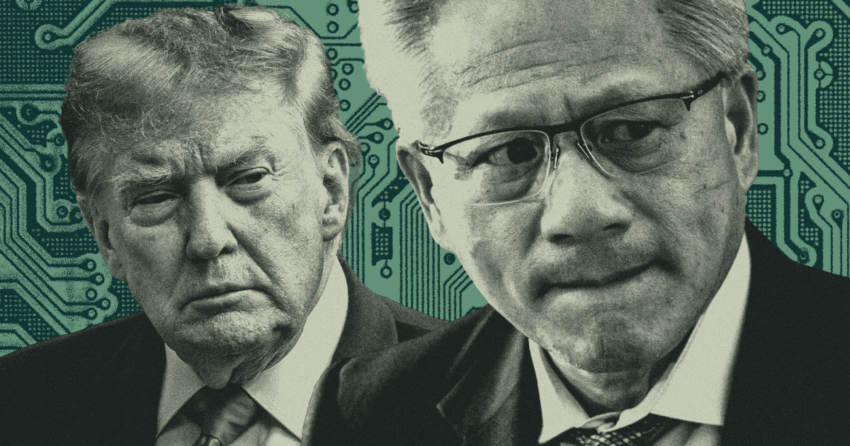

Mother Jones illustration; Ezra Acayan/Getty; Woohae Cho/Getty
A computer chip the size of a postage stamp has yielded one of the most significant political scandals in modern US history—and one of the Trumpiest of the Trump era. This still-unfolding Nvidia story features stunning incompetence, brazen corruption, blatant disregard for national security, corporate malfeasance, hubristic elitism, and sex. And the backdrop for all this is the transformative technology of artificial intelligence—which could offer great benefits to humanity, as well as spur immense dislocation or, as some AI experts have warned, possibly kill us all.
Perhaps the most profound take-away of the Nvidia mess at this point is that the people in control of this frightening new world are jerks and jackasses who don’t deserve to be in charge of the IT department at a local paper supply business.
Though there’s still much more to learn, the basics of the scandal are well-established. Jensen Huang, the founder and CEO of Nvidia, which manufactures the super chips that power the most powerful AI, had an extramarital affair with a woman named Alice Huang (no relation), who was an executive at Megaspeed, a Singaporean technology company that bought billions of dollars in chips from Nvidia. She was allegedly identified by US intelligence as a Chinese intelligence asset—though that determination has been challenged.
Huang-gate reveals a far greater problem. The United States—and to some extent the world—is at the mercy of an incompetent and grift-driven regime.
Whether or not Alice Huang was a modern-day Mata Hari, Megaspeed used Nvidia’s chips for data centers throughout Southeast Asia that could rent out computing power to Chinese firms—providing a work-around for China, which has been blocked by US authorities from obtaining the most powerful of Nvidia’s chips. But US authorities have suspected Megaspeed was also illegally smuggling Nvidia chips to China.
The salacious part of this saga is the prospect that Huang, one of the richest men in the world, was honey-trapped and somehow this led to the sly Chinese snagging his firm’s precious chips. And who knows what can happen if the Chinese possess these chips as they, too, rush to develop AI models without sufficient oversight and guardrails?
The Huang drama—he reportedly had at least two other extramarital affairs with employees at Nvidia—is a reminder that a handful of super-rich and often arrogant tech lords are making what could be civilizational life-and-death choices for the rest of us. Some of this cohort even want to see Huang, who resigned from Nvidia, back at his post. A petition calling on Nvidia to reinstate Huang has been signed by 180,000 people, including Elon Musk. And Donald Trump said he “would not mind” if Huang returned to the top post at Nvidia, adding, “I think he learned a big lesson.” (Cavorting with a possible Chinese spy and violating Nvidia’s HR rules about sleeping with subordinates is not disqualifying, as far as Musk and Trump see it.) The Nvidia board shows no signs of inviting Huang back.
This scandal extends far beyond Huang’s indiscretions and highlights the most pressing concerns of the moment. How should AI be developed? Who determines what is safe for AI? What should or should not be shared with China or other countries as a matter of national security (or humanity preservation)? These are not decisions for a small number of men, such as Huang, Musk (xAI), Sam Altman (OpenAI), or Dario Amodei (Anthropic). We are all stakeholders, and that’s why government ought to be addressing these questions.
But just when the American public—and the entire world—desperately needs a competent administration in Washington that can take on these heady subjects in a manner solely guided by what’s in the public interest, at the helm is Trump and his grifty clown show. No surprise, the subplot of the juicy Huang-Huang story is what Trump knew and when he knew it.
Like other tech titans, Huang has sucked up to Trump, flattering him and winning praise from Trump. In April 2025, Huang attended a donors dinner at Mar-a-Lago. The admission fee: $1 million. His firm also donated $25 million for Trump’s new White House ballroom.
Later that year, he and Trump went into business together. In October 2025, administration officials persuaded Trump not to permit Nvidia to sell its high-end Blackwell chips to China. Weeks later, Trump allowed Huang’s firm to export a less powerful chip there in return for 25 percent of that revenue going to the federal government. This was the kind of deal a mob boss imposes—and a very dodgy arrangement. With the Trump administration a partner of Nvidia, it was placed in the position of having to regulate an entity in which it had a financial stake.
And perhaps also investigate—for, as The New York Times has reported, Trump in October 2025 was briefed that Huang was involved with Alice Huang and US intelligence suspected she was an operative for China. Trump did nothing. He didn’t want to harm Nvidia, whose chip sales were fueling the US economy, or complicate matters with China.
The Case of the Tech Exec and the Chinese Spy went nowhere.
In May, Marco Rubio, the secretary of state and national security adviser, drafted a highly classified memo for Trump warning the president that Jensen Huang had become close to a suspected Chinese asset. That caused Trump no pause. He invited Huang on a trip to China and noted he was honored to have “the Great Jensen Huang” accompany him.
Trump apparently took no steps to deal with this pressing national security problem. In September, he called into a podcast featuring Huang. The two fanboyed each other, and Huang hailed Trump’s low-regulation approach to AI. On October 8, Trump awarded Huang and other executives the National Medal of Science. Three weeks later, the news of Huang’s relationship with Alice Huang broke.
Trump has since said that he had known nothing of Huang and Huang when he traveled with the Nvidia exec to China in May and that he only learned of this national security crisis “not too long ago.”
That seems to be a lie. Though much remains unknown, it looks as if Trump ignored the warnings about Huang because he fancied the guy (who happened to have contributed $1 million to him); was in a deal with Nvidia; cared more about keeping Nvidia (and the market) in strong standing than dealing with a threat to national security; and didn’t want to piss off his buddy, Chinese President Xi Jinping. This week, before leaving for a diplomatic summit in the Philippines and then a trip to China that both would include meetings with Xi, Trump showed no concern about the Nvidia scandal, remarking, “You know, we’re heading to China, and I don’t think you want to insult China just before you get there.” When he met with Xi, Trump reportedly said nothing about Nvidia and Chinese spying.
And there’s more. Trump traded Nvidia stock dozens of times in 2025 and 2026, meaning he had a personal financial interest in the company and Huang. (The White House claims outside managers handle Trump’s stock portfolio.)
Trump is not the only player in this scandal with a serious conflict of interest. Commerce Secretary Howard Lutnick, according to Axios, also received the warning that Huang was involved with a suspected Chinese spy. And his agency did nothing and took no steps to block Nvidia from selling chips to Megaspeed. Last week, Treasury Secretary Scott Bessent threw Lutnick under the bus, noting that his own agency, the Pentagon, the State Department and the US Trade Representative each favored blacklisting Megaspeed. “But Commerce has the pen,” he said, adding, “You will have to ask them about their internal processes.”
Before joining Trump’s Cabinet, Lutnick ran Cantor Fitzgerald, a New York investment bank which reportedly then held $1.2 billion in Nvidia stock. The firm is now run by his two eldest sons. And Lutnick, too, has been best buds with Huang. Within the administration, Lutnick has advocated for fewer restraints on Nvidia chip sales—including those to data centers in Southeast Asia that are clients of Cantor Fitzgerald and that supply computing power to Chinese firms.
The tangle of real and potential conflicts involving Trump, Lutnick, and Huang is a mess—a scandal of its own. When it comes to the contentious issue of chip sales to China, how can the American public have faith that decisions are being rendered with only the best interests of the nation in mind? Another question is what the FBI and Justice Department did regarding the possibility that Huang was in bed with a Chinese intelligence asset. Was there a criminal or counterintelligence investigation of Trump’s pal and supporter? If not, why not? Inquiring minds in Congress ought to dig into this.
Yet Huang-gate reveals a far greater problem. The United States—and to some extent the world—is at the mercy of an incompetent and grift-driven regime. Trump has largely abandoned the government’s duty to responsibly oversee the development and use of AI. He has allowed the tech barons to proceed as they wish, calling for nothing more than self-regulation. Trump is concerned mostly about preserving the AI boost to the stock market and doesn’t want to impede the tech royalty. Meanwhile, the Kings of Silicon Valley rush forward into the unknown, pocketing billions and assuming powers and influence that no previous robber baron could dream of. They are gambling with our world.
This scandal warrants full-scale attention, for it illuminates the unscrupulous and untrustworthy crew that controls what could be the fate of humanity. As important as the Watergate, Iran-Contra, and Trump-Russia scandals were, none had such high stakes. This week, Paul Christiano, an OpenAI board member, said, “There is a reasonable chance we’re in a world where, in six months, there’s a disaster that kills very large numbers of people, or where the government is overthrown.” A top safety researcher at Anthropic recently observed there is a greater than 10 percent chance that “AI could kill all humans.”
The future of us all should not be in the hands of Jensen Huang, Donald Trump, and other self-proclaimed masters of the universe, men of poor judgment, dubious ethics, and suspect motives. The Huang-Huang affair is more than just a steamy tale of the downfall of a wealthy and arrogant tech giant who believed the rules did not apply to him. It’s a window into the corrupt world of those who are determining what comes next for our species.