

Damien Ma is the director of Carnegie China in Singapore.
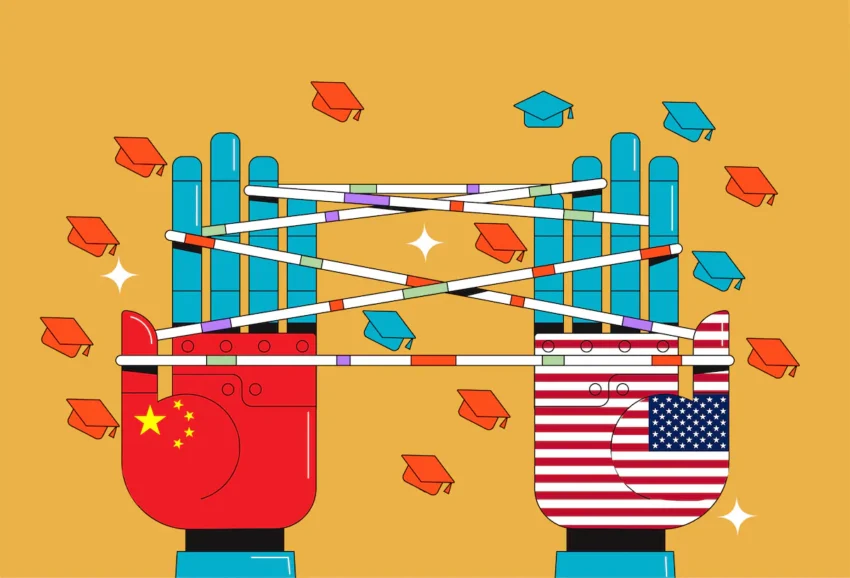
The most important commodity in the world today is not oil, gold or some obscure rare earth mineral but top artificial intelligence talent. And it’s a safe bet that the country that amasses more of it — by developing its own and welcoming it from elsewhere — will win the AI marathon.
Right now, China is producing more of this top talent — much more — than the United States. But the U.S. is significantly better at attracting the best of the best from around the world, including from China. To counteract Beijing’s deep bench, the U.S. needs to have a long-term strategy to sustain its talent pool. In the near term, however, maintaining an environment that fosters openness and freedom of inquiry is crucial for attracting the world’s top talent.
Consider Kaiming He, a Chinese computer scientist. He was recently tenured at MIT, but his trajectory began when he won first prize in the national physics olympiad in China, earning him a seat at Tsinghua University. After completing a doctorate in Hong Kong, He landed at Microsoft Research Asia’s lab. It was in that American lab in Beijing — something of an artificial-intelligence-talent factory — that he co-published a 2015 paper on deep residual learning that has become the most cited of this century, according to Nature. The paper’s central ideas sit inside virtually all generative AI models, including Open AI’s ChatGPT and Google’s Gemini. (The Washington Post has a content partnership with OpenAI.)
Before settling in Boston, He followed a path well-trod by other AI luminaries — such as Stanford University’s Fei-Fei Li — who were born in or received their undergraduate educations in China but left to make their careers in the United States. Li, widely considered the “godmother” of AI, grew up in China’s Sichuan province and landed at Princeton University, where she did pioneering work on computer vision. World Labs, co-founded by Li, was recently acquired by Advanced Micro Devices for $8.2 billion. These are the elite of the elite, and they are most likely to produce the cutting-edge work that advances AI.
To maintain an edge in the AI race and keep pace with China’s talent production, the U.S. will have to remain a target for the world’s best and brightest.
Considering all this, it’s unsurprising that America and China continue to nip at each other’s heels in the race to release frontier models. American models are built domestically but with significant Chinese talent. China, meanwhile, has a deep pool of talent but limited access to high-end semiconductors and other necessary components and infrastructure.
In April, when OpenAI live-streamed the launch of its Images 2.0 feature, attention on social media fixated on the fact that chief executive Sam Altman was flanked by young Asian AI researchers, at least half of whom were of Chinese origin. A leaked but unconfirmed roster suggested that Meta AI chief Alexandr Wang’s lab was initially composed of 50 percent Chinese talent.
China’s human-capital advantage took at least two decades of deliberate effort and cultivation before results started showing. And those returns have been astounding: In 2020, China awarded about 1.7 million bachelor’s degrees in science, technology, engineering, and mathematics, outside of social sciences, compared with just half a million in the United States.
In this age of parallel technological revolutions, STEM talent reigns supreme. Further, China’s human-capital strengths across STEM fields will be exceedingly difficult to replicate because talent cultivation is a multi-decade endeavor.
That’s why China’s talent density presents a paradox for the United States. America’s rapid pace of progress on frontier AI depends in large part on a pool of top talent that originates from the country that America is competing against. But the scarcity of elite AI researchers, combined with U.S. domestic deficiencies, means that — for now — there is little choice but to embrace the competition for that global talent.
Even as tensions between the U.S. and China are likely to persist, policymakers should be careful not to cripple American access to AI talent in the name of national security. Though legitimate national security concerns should be addressed, such as preventing rivals from acquiring the most critical technologies, small steps can be taken to signal that the environment for foreign talent is shifting. One such step would be to revoke a presidential proclamation enacted during the first Trump administration that restricted entry of Chinese graduate students and researchers.
The AI age is still in its infancy, and the race for supremacy is a marathon that can’t be won without stamina, patience and, above all, the highest performers. China’s superpower is its ability to produce those top talents. The U.S. advantage is the country’s ability to attract and retain them. Human capital, wherever it can be found, is the indispensable ingredient to keeping the U.S. in the lead in the miles ahead.
About this story
Design and development by Yan Wu.