
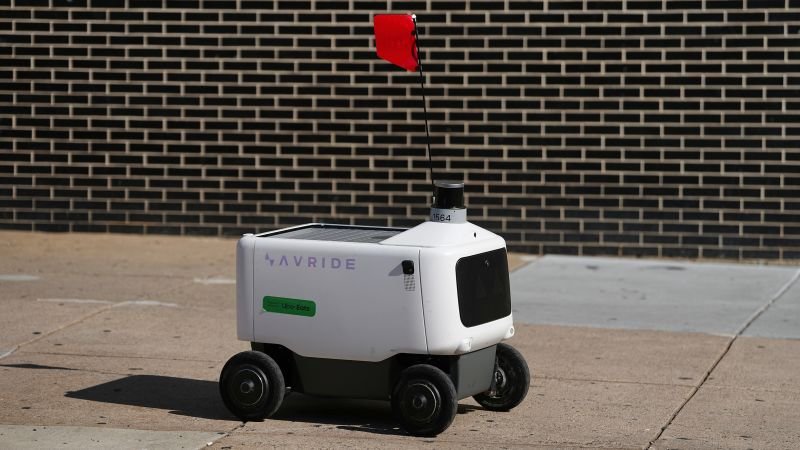
October 14 wasn’t the first time Carolyn Marvin put herself in front of an autonomous delivery robot. It had become, since the wheeled little food vessels were unleashed upon certain parts of Philadelphia, a habit for the 78-year-old: standing in front of one of the robots when she encountered it rolling on the sidewalk, delaying it for a few minutes from delivering its precious lunchtime cargo.
But it was the first time that Marvin, a retired University of Pennsylvania communications professor, was arrested for doing it — in a case that she says raises profound questions about public space and the legal protections extended to robots in our increasingly tech-dominated world.
“I was under the impression that I had more rights than the robot did,” Marvin said, laughing.
Uber Eats launched its self-driving robot delivery fleet in Philly in March, making it the fourth city where meals can be delivered via robot. Not everyone welcomed the heart-eyed little machines: In Philadelphia and elsewhere, videos show people sitting on, vandalizing or kicking the robots.
Marvin says the impact of her one-woman protest is limited. “I have a life, so I don’t have tons of time to stand in front of robots,” she said. If she comes across a robot, and it’s “convenient and possible” for her, she might spend 10 or 15 minutes blocking it, moving as it does, to delay it on its journey.
The only harm that comes from her hobby is that an office worker’s lunchtime bowl “might be delayed for about 15 minutes at the most,” she said.
She views her actions as a symbolic protest against the problems posed by delivery robots: the displacement of low-income delivery workers; the physical hazard the robots pose on the sidewalk; and the privacy concerns posed by the robots’ embedded cameras.
“I also think that I have a First Amendment right to protest the abuses of corporations in public space, in the same public space that the robots are occupying,” she said. In the past, she had protested in favor of civil rights, abortion rights, Black Lives Matters, and for ending the Gulf and Vietnam wars. She views her robot mission as an extension of the same impulse: “It’s what we need to do to make sure the government hears the will of the people.”
Stopping in front of the robots, Marvin said, led to productive conversations with other passersby who asked what she was doing. Most were supportive, or curious. She never considered that she might be arrested, since, as she said, “I wasn’t impeding any persons. I was impeding a machine.”
That’s until the 14th. On the way home from getting her flu shot, Marvin, a jar of enchilada sauce in one hand and chicken biryani takeout in the other, encountered one of the robots and stopped in front of it, per usual. It was in a busy part of the city, and a larger-than-normal crowd began to gather around her. Some were supportive; some were critical. She suspects, she said, that a member of the crowd eventually called the police, who handcuffed her and put her in the back of a squad car, giving her a citation for disorderly conduct.
Marvin said one of her friends put it thusly: “Well, you got a disorderly conduct charge for impeding capitalism.”
Philadelphia police said that they had responded to a report of “criminal mischief involving a delivery robot.” When they arrived, “officers encountered a female who was refusing to allow a delivery robot to pass,” they wrote in an email. “Police issued multiple commands directing the female to move; however, she refused to comply.”
In the aftermath of her arrest, Marvin has found out more about the legal infrastructure that protects robots. In 2020, the Pennsylvania legislature passed a law that classifies autonomous delivery robots — what the law calls “personal delivery devices” — as pedestrians, not vehicles. Democrats, along with labor unions and accessibility advocates, largely opposed the law on the basis that legalizing delivery robots could kill jobs and endanger children and pedestrians; Republicans touted it as an exciting technological advancement.
The law means that a vehicle must yield to a delivery robot on crosswalks, just as it would to a person, said John Mattiacci, a Philadelphia personal injury attorney. Still, in theory humans are at the top of the hierarchy: “Personal delivery devices must yield to other pedestrians and pedalcyclists in a pedestrian area,” he said. Uber Eats didn’t respond to a request for comment.
Marvin sees the proliferation of delivery robots — and the legal protections of them — as another case of machinery and technology infiltrating everyday life. “There’s a way in which we’ve surrendered the streets to cars long ago, and I don’t think we should surrender the sidewalks to machines,” she said.
“Machines in general encroach on our lives,” she went on. “Public space is the most visible place where they’re encroaching on our lives, but they’re going right up the ladder, and lots of people are interested in making that happen.”
Most of the technology people encounter day to day is less tangible: the overwhelming adoption of AI, the mysterious social media algorithms that determine the images and narratives the public consumes. The robots, on the other hand, are a clear and visible symbol of the tech takeover, an easy target for anti-tech rage. Her protest, she said, “makes it visible to people and presents the issue in a way that it might not otherwise be presented.” Asked if she plans to get back to blocking robots post-arrest, Marvin was succinct: “Oh yeah.” But now she’ll keep an eye out for the cops.