
Jensen Huang is having a rough month. In early November, the founder and chief executive of Nvidia, the chip-maker company that powers the artificial intelligence industry, admitted to having an extramarital affair.
Worse, news reports allege that the woman Huang had an affair with is suspected of being Chinese spy. Huang is currently being investigated by his company’s board following reports that he was “the target of a foreign intelligence effort.” His every move is also being analyzed by online detectives trying to suss clues about his current state of mind from what he is wearing.
On top of the real admission of an affair and the troubling cybersecurity implications of the Nvidia scandal, people online are also using artificial intelligence to spread their own false narratives of Huang on social media.
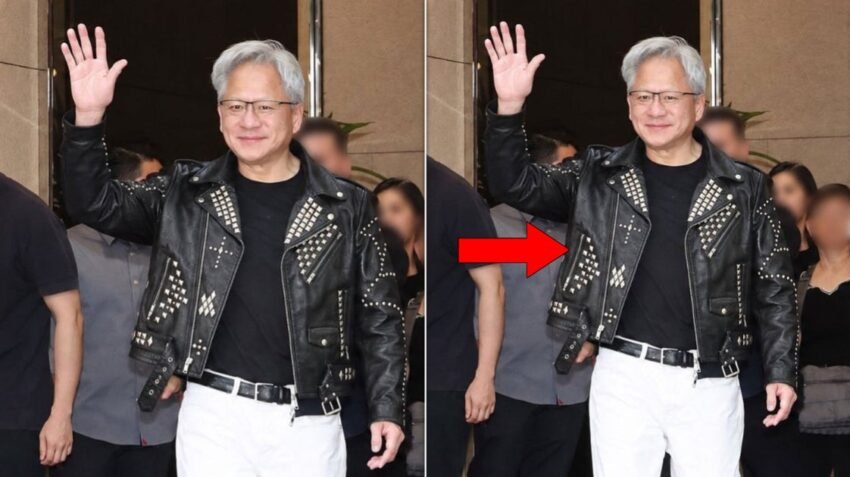
One of the most popular images displays Huang wearing a heavily studded leather jacket that features a cross. The ostentatious style looked like an archival biker jacket from designer Hedi Slimane, the designer and former creative director for Saint Laurent. “His bad boy arc,” one person replying to the image wrote, while another commenter wrote that the image suggests “midlife crisis final boss.”
The problem is that the studded-jacket image is not a real photo of Huang.
The photo, which was altered by AI, appears to use real Getty Images photos taken of Huang this June in Seoul. But in the real photos, Huang is wearing a slim-fitting jacket, not a leather-studded number.
HuffPost reached out to Nvidia about the viral AI-manipulated image and did not immediately hear back.
The AI-altered images fooled so many, in part because they played upon well-established facts. Huang does consistently wear black leather jackets in public appearances. He owns 30 to 40 leather jackets, as he told a CBS interviewer: “It’s nice to wear the same thing every day … It all fits the same way, feels the same way.”
Huang is indeed going through a real public relations nightmare, but the flashy jacket being used to make fun of his corporate crisis is fake. Is there a way for viewers to catch an AI-generated meme before they spread misinformation? Even the world’s leading deepfake experts say that AI-manipulated images are tough to catch right now.
Hany Farid, a Dartmouth College computer science professor who studies artificial intelligence deepfakes, said that AI-generated images are becoming so realistic that the usual tells are no longer reliable.
“Generally speaking, our studies have shown that the average person cannot reliably distinguish authentic from AI-generated images or video,” he told HuffPost.
But there is one obvious sign people can and should watch out for before they start sharing a viral image online.

Illustration: HuffPost; Photo: (L to R) AI Generated / Jung Yeon-je / Getty
The biggest giveaway that Huang’s ostentatious leather jacket is AI is embedded into the image itself.
“This image that is being widely shared contains an invisible watermark,” Farid said.
To prove this, Farid ran the image through an AI verification service known as SynthID, which was developed by Google DeepMind.
When you upload the viral jacket image into SynthID, the AI detector will state: “This media was made or edited with OpenAI. Please note that this media may have been edited further since then.”

You too can also can use Synthid.com to check if a suspicious audio, image or video contains one of these digital watermarks that suggest its AI origins. SynthId checks across Google, Nvidia, OpenAI and Kakao models, but it’s not a guaranteed way to prove if what you are seeing or hearing has been manipulated by a large language model.
“Only a few AI models insert these watermarks so while the presence of a watermark is informative, the absence is not,” Farid said.
At worst, Huang’s fake leather jacket perpetuates false ideas of his style, but on a deeper level, it contributes to the growing erosion of reality. When seeing is no longer believing, people can start to question even real photos and facts.
“There is a broader harm in that as we continue to pollute the information ecosystem with AI slop like this, people will become suspicious of any content, including authentic content,” Farid said.
You should be on alert when images appear designed to elicit strong emotions. “I do think it’s important that we get people to automatically question the authenticity of viral images so that a conversation starts immediately about whether they’re real or not,” said Steven Sloman, a Brown University cognitive psychologist. “I don’t think this will negate their effect entirely, but it will dilute it by altering the conversation.”
To avoid consuming AI slop, get your facts from verified media sources, not random social media accounts. Watch out for signs of the “AI accent” in videos that suggest a voice was generated by AI. And know that if a meme feels too on-the-nose or too funny to be true, it probably is.