
You’ve probably heard the saying: Don’t believe everything you see on the internet. That’s doubly true in the age of AI, where much of the content you come across online may have been edited, written by or entirely generated by bot.
Now, the latest TikTok and Instagram trend is having a lot of fun with that fact.
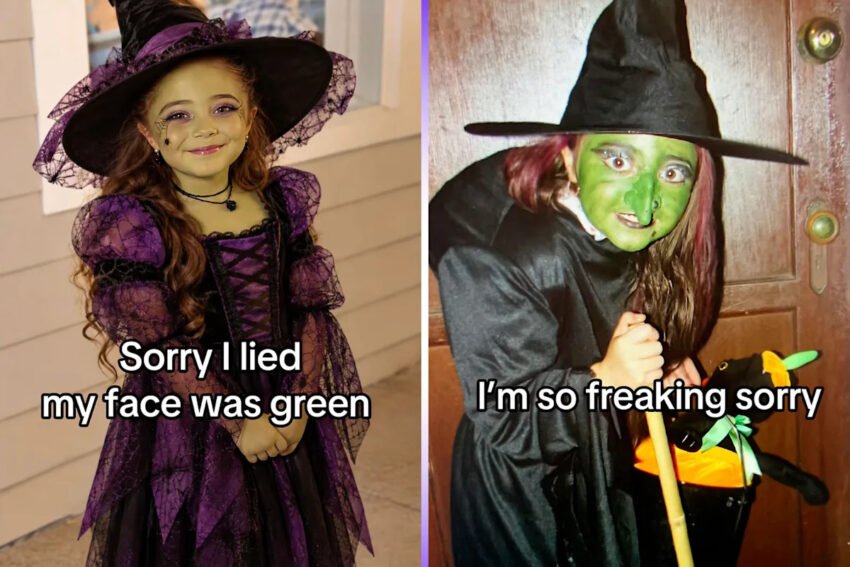
Take this sweet Halloween photo of a little girl, posted by TikTok user Gracelynn Figueroa. At first, she’s shown as pretty and polished as a stock image, in a cutesy witch outfit that would draw more “awws” than screams. Then comes an admission: “Sorry I lied my face was green.” The photo flips accordingly.
Another confession: “Sorry I lied again my dress was black” flashes on-screen as the purple lace dress turns black. OK, a slightly spookier witch. What else could possibly be altered?
At last comes the reveal of the original photo, and it’s a jump scare. The little girl is glaring at the camera, wearing a black satin cloak and a witch hat. For some reason, she has a hunched back and a wig that hardly disguises her natural brown hair. Her face is a lime green, complete with a terrifying prosthetic nose. This little Wicked Witch committed to the role — and looks nothing like the first image we saw. “I’m so freaking sorry,” reads the caption.
That’s the setup of the viral “I’m so sorry” trend, where social media users are employing AI to give a personal photo a glossy makeover, before the edits are gradually walked back until the real picture delivers the punchline. People are doing it with school portraits, baby pictures and even postpartum snaps taken after giving birth, with many of the posts racking up tens of millions of views over the last week.
The more you’ve been misled by the opening image, the harder the original lands. And for once, the suspiciously perfect picture is just something to get through. Everyone is waiting for the unedited reveal.
“What I find especially amusing is how the trend turns the usual social media experience upside down,” Paromita Pain, an associate professor of global media at the University of Nevada, Reno, tells Yahoo.
Normally, people edit an ordinary image to make themselves look better, without acknowledging what’s changed. Here, calling attention to the edits is the whole joke. “You know something funny is coming, but the final photograph is often so unexpected that you can’t help laughing,” she says.
School pictures offer particularly promising material. Those annual portraits already have a way of preserving a haircut or outfit long after you’ve stopped wanting photographic evidence of it. They’re even funnier with an uncanny upgrade, followed by a very public correction.
Baby photos and pictures of mothers in the delivery room also provide rich fodder. Looking like a Victoria’s Secret Angel after delivering a baby might be the fantasy, but showing off your naturally exhausted face and a big smile can actually make the preserved moment more worth celebrating.
Melissa Connelly, who did the trend with a photo of herself after an emergency C-section, wrote “Why is this trend SO HUMBLING?!?” in the caption.
Her commenters had a different takeaway. “First one I’ve seen more beautiful than the AI,” one person wrote. Another said, “First time I’m not cackling at the final slide. You look amazing and you’re a badass!”
Naturally, there’s suspense in waiting for the ending. Once you understand the format, you start looking for clues about what’s been altered. Is it the hair? The outfit? How much of this picture is going to survive the next few swipes?
Viewers are left laughing both at the photos and at themselves for being so unprepared for where the buildup would lead them.
The reactions aren’t usually at the expense of whoever’s captured in an awkward or unflattering pose. Instead, the laughs come from a place of recognition — we’ve all been there, but the users posting are simply brave enough to revisit those candid moments.
There’s also something wonderfully retro and charming about the unedited originals, most of them taken before AI had the ability to zap an image to eerie perfection in seconds.
“This is a way of reminding users that we’re human and we look like humans do, imperfections and all, and that is way more beautiful than slop,” Jamie Cohen, an associate professor of media studies at CUNY Queens College and author of Critical Internet Literacies, tells Yahoo. “The trend is actually funny because of its endearing and anti-platform aesthetics.”
Of course, some viewers would prefer to skip the artificial glow-up altogether. Critics on X have dismissed the trend as “AI slop,” and would prefer not to see images generated by bots altogether.
But Cohen sees a distinction: The trend uses AI “but removes the veneer of the pseudo-perfection expected on visual social media,” he says.
Pain similarly sees it as people enjoying technology while also questioning the idea that everything they share online needs to be flawless. “People are using AI to make fun of AI itself,” she says. “When technology can make almost anyone or anything look perfect, perfection itself starts to feel a little less special.”
The original offers something else: a laugh, a familiar memory or a moment that needed no improving. Whether it’s a little girl fully committed to being a terrifying witch or a mother smiling after giving birth, the real picture is the one worth sticking around for. No apology necessary.